Life and legacy
The Life and Legacy of Jagadguru Adi Shankaracharya
Welcome to our digital ashram. This page serves as a foundational pillar for seekers around the globe, guiding you through the profound spiritual journey of Adi Shankaracharya.
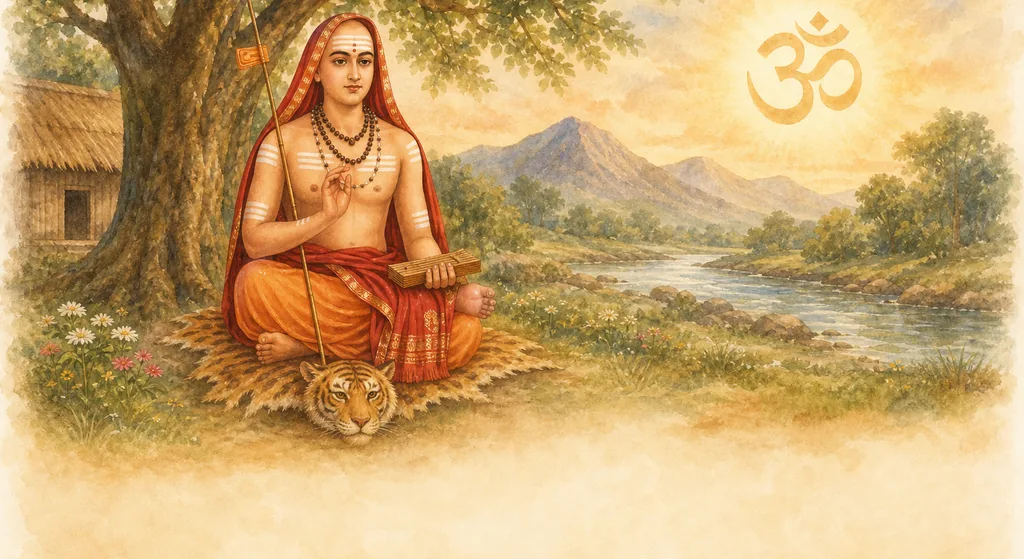
Who Was Adi Shankaracharya?
Adi Shankaracharya was an 8th century philosopher and reformer who consolidated Hinduism through Advaita Vedanta, also known as Non dualism. He was born to Shivaguru and Aryamba in Kalady, a village on the banks of the Periyar River in Kerala. Recognized early as a child prodigy, he mastered Vedic texts at a very young age and soon left home to find a spiritual preceptor. He eventually met his guru, Govinda Bhagavatpada, on the banks of the river Narmada. In his brief life, he attained Mahasamadhi at the young age of 32 in Kedarnath, Uttarakhand.
The Philosophy of Advaita Vedanta
Shankaracharya systematized the philosophy of Advaita Vedanta. This ancient philosophy posits that there is no difference between the individual soul, known as Atman, and the ultimate reality, known as Brahman. His teachings are powerfully summarized in a core Sanskrit phrase.
Brahma Satyam Jagat Mithya, Jivo Brahmaiva Naparah
Brahman is the only truth, the world is an illusion, and the individual soul is ultimately Brahman.
He explained that the empirical world is an illusion created by cosmic ignorance, which veils the true nature of Brahman.
Unifying Sanatana Dharma
Adi Shankaracharya is revered as a great unifier of Indian spiritual traditions.
- The Shanmata System: He formalized the Shanmata system, which translates to six modes of worship. This system centered on six primary deities: Shiva, Vishnu, Shakti, Ganesha, Surya, and Skanda.
- Panchayatana Puja: He introduced Panchayatana Puja, a ritual where a primary deity is worshipped along with four others. This practice symbolized that all forms are simply manifestations of the one Brahman.
Establishment of the Four Mathas
To ensure the continuity of Vedic teachings, Shankaracharya established four Mathas, or monastic centers, in the four cardinal directions of India.
- North
Jyotir Pitham in Badari
- East
Govardhana Pitham in Puri
- South
Sharada Pitham in Sringeri
- West
Kalika Peetham in Dwaraka
Literary Contributions and Works
Adi Shankaracharya was a prolific writer who left behind a monumental body of philosophical work. His texts are categorized into three main areas.
1. Prasthanatraya Bhashyam
He wrote extensive commentaries on the three authoritative texts of Hinduism. These texts include the Upanishads, the Bhagavad Gita, and the Brahma Sutras.
2. Prakarana Granthas
These are independent philosophical manuals designed specifically for students. Notable examples include Vivekachudamani and Atma Bodha.
3. Devotional Stotras
Despite being the leading proponent of the path of knowledge, he composed moving hymns to foster devotion. These exact verses are the heart of our platform, offering word by word transliterations to bridge the gap for modern readers. Some of his most famous compositions include Bhaja Govindam, Soundarya Lahari, and Nirvana Shatakam. Browse the full stotra library to read and study these hymns.
Frequently Asked Questions
- When was Adi Shankaracharya born?
- He was born in Kalady, a village on the banks of the Periyar River in Kerala.
- What is the core philosophy of Advaita Vedanta?
- Advaita Vedanta is a philosophy which posits that there is no difference between the individual soul, known as Atman, and the ultimate reality, known as Brahman.
- What are the four Mathas?
- The four mathas established by Adi Shankara are Jyotir Pitham in Badari, Govardhana Pitham in Puri, Sharada Pitham in Sringeri and Kalika Peetham in Dwaraka.
Begin with six verses
Nirvana Shatakam is the shortest complete work in the opening collection and the clearest introduction to the layered reader.
Read Nirvana Shatakam