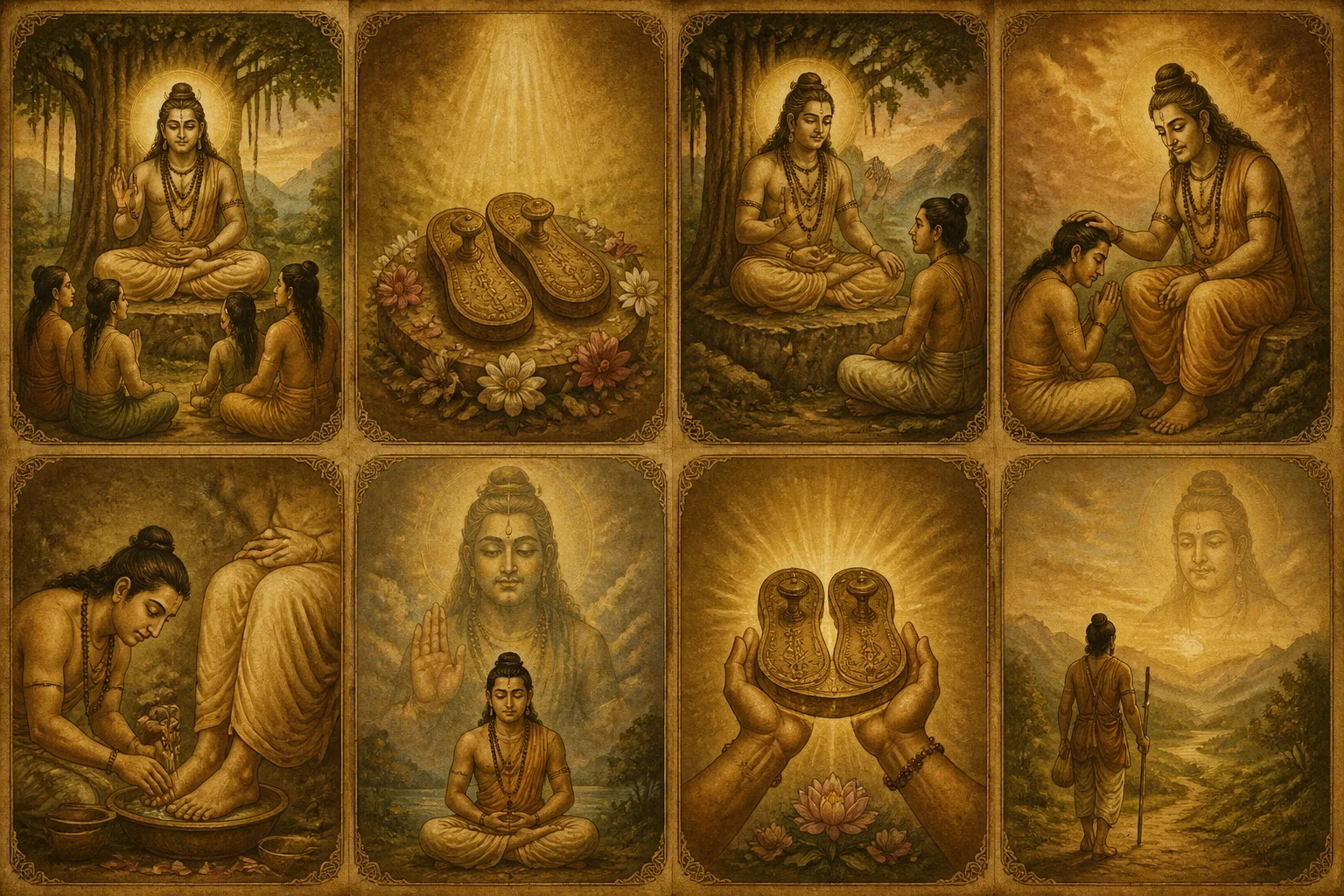
Complete · ~4 min chant
Gurvashtakam
गुर्वाष्टकम्
Gurvāṣṭakam
Eight refrains on the futility of worldly attainment without the mind fixed on the Guru's lotus feet.
8 verses · About 4 min · Guru and Dakshinamurti
How do you want to read?
New here? Read the full text first, or go verse by verse to chant.
Gurvashtakam is eight verses on devotion to the guru, traditionally attributed to Adi Shankaracharya. Many recite it on Guru Purnima and in daily remembrance of the teacher. This edition includes Sanskrit, English meaning, and study notes.
Gurvashtakam is a celebrated eight-verse hymn attributed to Sri Adi Shankaracharya. Its refrain, tatah kim ("what then?"), rings through every stanza: beauty, wealth, learning, fame, power, and pleasure are repeatedly weighed against one question. Is the mind anchored at the lotus feet of the Guru?
More about this stotra
The poem is direct Advaita bhakti. It does not reject the world with contempt, but exposes what happens when the ultimate refuge is misplaced. The Guru here is not merely a personality; he is the visible sign of grace through whom the disciple learns to turn inward toward the Self.
Tradition places this hymn among the core guru-stotras recited on Guru Purnima and during guru-puja. The eighth verse is often read as phala shruti, promising Brahman to one whose mind rests on the Guru's words. This edition follows the standard eight-verse recension with curated editorial focus notes for each verse.
At a glance
- Verses
- 8 verses
- Chant time
- About 4 minutes
- Attribution
- Traditionally attributed to Adi Shankaracharya
- Sanskrit source
- sanskritdocuments.org · All sources
- Occasion
- Often recited on Guru Purnima
- Theme
- Guru bhakti and the teacher as the path
- Guide
- Reading guide
Traditional context
Gurvashtakam is recited on Guru Purnima and during guru-puja across Advaita lineages. Its refrain tatah kim asks what use are beauty, wealth, learning, and power if the mind is not anchored at the Guru's feet.
The Guru is praised as the visible sign of grace through whom the disciple learns to turn inward toward the Self.
Structure of this recension
Eight verses weigh worldly accomplishments against discipleship. The eighth verse is often read as phala shruti, promising Brahman to one whose mind rests on the Guru's words.
The tone is direct Advaita bhakti: uncompromising yet compassionate.
How to read this edition
Each verse includes editorial focus notes on guru-bhakti and inner silence. These are study aids, not a substitute for living discipleship or traditional teaching.
Suggested practice
Recite on Thursdays or Guru Purnima. Pair with Dakshinamurti Stotram and Guru Paduka Stotram in the guru collection.
Verse overview
- 1
Beauty, spouse, fame, and vast wealth avail nothing without the mind fixed on the Guru's feet. Outer perfection cannot substitute for the inward turn toward…
- 2
Family, home, and kindred are born and pass away. Without devotion to the Guru's feet, even the dearest bonds cannot free one from the cycle of becoming.
- 3
Mastery of Vedas and poetic skill is empty if the mind is not anchored at the Guru's feet. Learning that does not lead to the Self remains ornament on the…
- 4
Honour abroad and righteous reputation still leave one bereft without the Guru's feet. Reputation is another form of bondage when the mind has not found its…
- 5
Kings may bow at one's feet, yet without the Guru's feet the mind remains unfulfilled. Worldly sovereignty over others means little without sovereignty over…
- 6
Fame, generosity, and worldly power do not secure liberation without the Guru's feet. The whole world in one's hand is still a handful of dream until the Self…
- 7
Neither pleasure, yoga, horses, beloved, nor riches satisfy if the mind avoids the Guru's feet. Even spiritual practice becomes another object of attachment…
- 8
The mind may wander forest, home, body, or duty, yet only the Guru's feet complete the path. Renunciation and engagement alike are fruitless until the mind…
All verses
Open full textRelated works
Common questions
- When do people recite Gurvashtakam?
- Guru hymns are commonly recited on Guru Purnima, Thursdays, and during remembrance of the teacher. This edition presents 8 verses and takes about 4 minutes to chant.
- What is the opening focus of Gurvashtakam?
- Beauty, spouse, fame, and vast wealth avail nothing without the mind fixed on the Guru's feet. Outer perfection cannot substitute for the inward turn toward the teacher of the Self. Read verse 1 in Study mode for the full editorial note beside the Sanskrit.
- Which hymns pair well with Gurvashtakam?
- On this site, related reading includes Guru Paduka Stotram, and Dakshinamurti Ashtakam. Open those hubs for their own Sanskrit, English meaning, and study notes.