Complete · ~55 min chant
Shivananda Lahari
शिवानन्दलहरी
Śivānandalaharī
A hundred-verse wave of bliss to Shiva, blending bhakti, yoga, and Advaita, attributed to Shankaracharya.
100 verses · About 55 min · Lord Shiva
How do you want to read?
Chant one verse at a time, or open the full text to scroll the whole hymn.
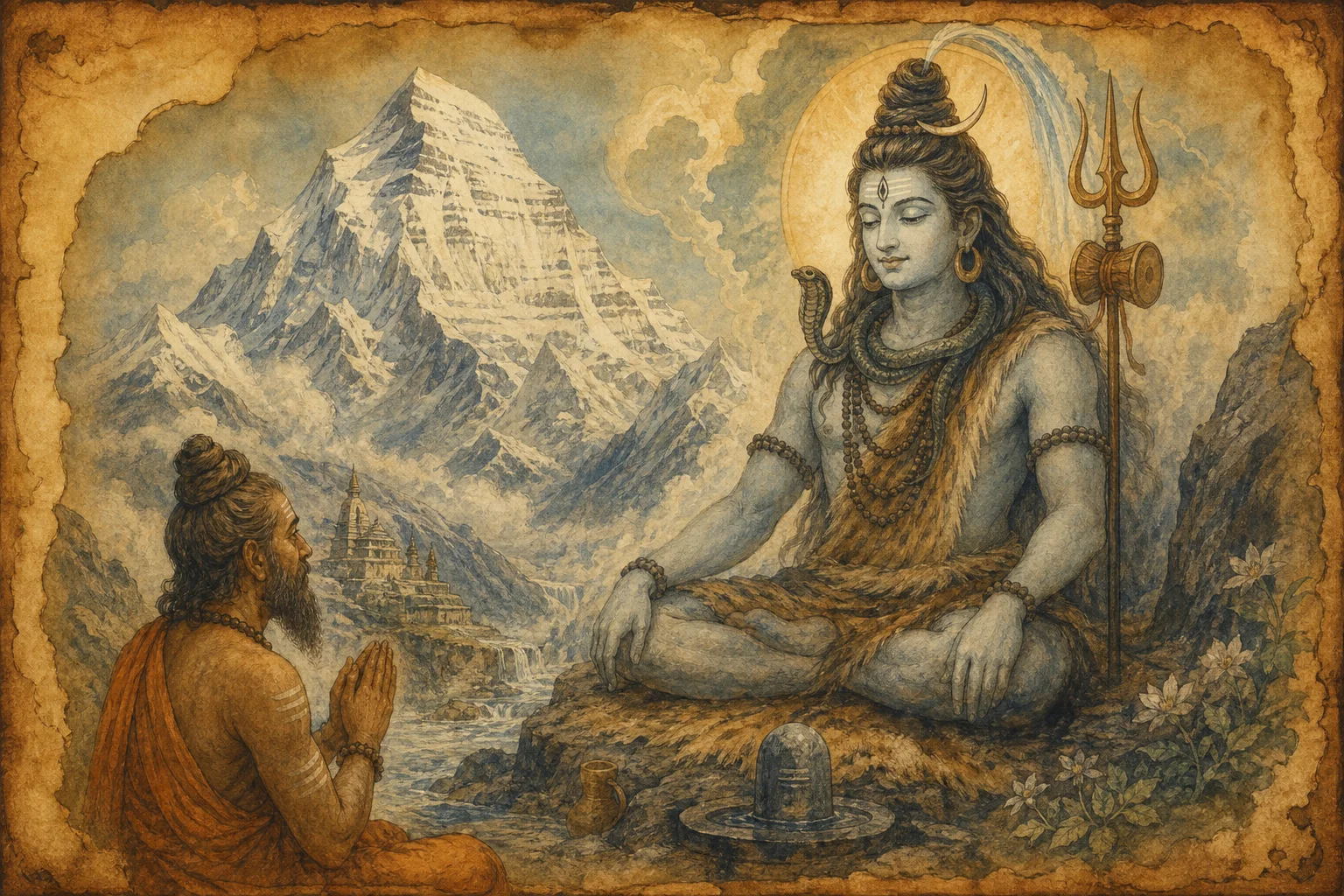
Shivananda Lahari (Wave of Bliss to Shiva) is a celebrated hundred-verse hymn attributed to Sri Adi Shankaracharya. Its title announces its mood: ananda, the bliss that overflows in praise of Mahadeva. The stotra moves from the inseparability of Shiva and Shakti through descriptions of the Lord's form, attributes, and cosmic play, into explicit Vedantic teaching and fervent prayers for grace.
More about this stotra
Tradition holds that Shankara composed this hymn during his travels, offering each verse as a flower at Shiva's feet. The work is often recited during Shravan and on Pradosham, and is studied alongside Soundarya Lahari as one of the acharya's two great lahari hymns. This edition presents all hundred verses with Devanagari, IAST, and editorial focus notes for contemplative study.
At a glance
- Deity
- Lord Shiva
- Verses
- 100 verses
- Chant time
- About 55 minutes
- Attribution
- Traditionally attributed to Adi Shankaracharya
- Sanskrit source
- sanskritdocuments.org · All sources
- Guide
- Reading guide
Traditional context
Shivananda Lahari, the wave of bliss to Shiva, is a hundred-verse lyrical hymn attributed to Shankaracharya. Tradition holds that he offered each verse as a flower at Shiva's feet during his travels.
It is widely recited during Shravan and on Pradosham alongside shorter Shiva stotras.
Structure of this recension
The hymn moves from Shiva-Shakti inseparability through vivid descriptions of the Lord's form, attributes, and cosmic dance into explicit Vedantic teaching and prayers for grace.
Its length rewards sustained daily practice over months rather than a single sitting.
How to read this edition
All hundred verses include Devanagari, transliteration options, and editorial focus notes for contemplative study.
Suggested practice
Chant five verses per day to complete the hymn in twenty days. Begin with Shiva Panchakshara or Nirvana Shatakam if you are new to Shiva stotras.
Verse overview
- 1
Salutations to Shiva whose form embodies austerity's fruit and blissful becoming. The Lord of beings is the inner witness in whom devotion recognizes the Self…
- 2
The river of Shiva's conduct washes away the dust of sin in the mind's channels. When devotion lets that stream dwell in the heart, the burning of worldly…
- 3
Shiva is the primal consciousness known to the Vedas, compassionate Pasupati and support of pure awareness. Heart-worship of the Lord with Uma is the…
- 4
Lesser gods grant limited fruits; the poet seeks only Shiva's lotus feet. True fulfilment lies not in pursuing small rewards but in devotion to the one Lord…
- 5
The devotee confesses unworthiness in every worldly art yet asks only for the Lord's protection. Grace does not require skill; the Self accepts the sincere…
- 6
No material symbol removes the terror of death; argument avails nothing. The wise turn from empty disputation to worship of Shiva's feet, where supreme bliss…
- 7
Every faculty offered to Shiva becomes the path: feet for the mind, praise for speech, worship for hands. When all senses rest in the Lord, no other teaching…
- 8
Like mistaking shell for silver, the ignorant worship lesser gods. The Advaitin sees all such appearances as misapprehension; only Shiva, the supreme Self, is…
- 9
The dull mind wanders through dangers seeking outward flowers while the simple offering of mind to Shiva brings abiding bliss. True peace is not found by…
- 10
Any birth becomes bearable when the heart rests in Shiva's feet. The body matters little if consciousness is steeped in the bliss-wave of remembrance; the Self…
- 11
Ashrama and status are irrelevant when the heart belongs to Shiva. The Lord Himself bears the devotee's burden; in Advaita this is the recognition that the…
- 12
Place of residence does not determine spiritual fruit; resting the mind on Shiva's feet does. Supreme yoga is constant inward abiding in the Lord, which is the…
- 13
The poet admits blindness in samsara and asks who else can save him. Shiva alone is refuge for the helpless; grace is the Self's own compassion turning the…
- 14
Shiva is kinsman of the destitute; the devotee claims that bond and asks forgiveness. True kinship with the Lord is not birth but surrender; offences dissolve…
- 15
The poet argues from Shiva's power over Brahma that He can remove the devotee's sins. If the Lord can crush pride effortlessly, grace can surely turn the mind…
- 16
Brahma's long life and cosmic office do not erase worldly poverty; Shiva's compassionate glance does. The Lord's grace actively seeks the destitute; the Self's…
- 17
Merit or grace, the devotee longs to see Shiva's feet hidden by bowing gods. Even divine ranks veil the direct vision of the Lord; humility before the Self…
- 18
All gods derive their fruit from Shiva and return to His source. The devotee's hope rests on that compassion which is the Self's own grace, ever able to…
- 19
Bound in desire and misery, the poet asks why Shiva does not remove his weariness. If the Lord's love is real, fulfilment is already present; suffering…
- 20
The restless heart-monkey roams the forest of desire. Binding it with devotion to Shiva is the practice of turning scattered mind toward the one Lord in whom…
- 21
The mind's hut is built on virtue and firmness to host Shiva. Conquest over Kama comes when the inner dwelling is made fit for the Lord; the Self enters the…
- 22
The heart-thief of desire roams seeking stolen pleasures. Surrendering that thief to Shiva transforms robbery into offering; the blameless Self is revealed…
- 23
Worship of Shiva brings exalted births yet the devotee grieves separation from the Lord. Even divine status is sorrow if it obscures direct vision of the Self;…
- 24
The poet longs for Kailasa worship before Shiva with joined palms. That vision compresses cosmic time into a moment of bliss; the Self known in devotion…
- 25
The beloved image is Shiva embraced by Uma, praised by gods and ascetics. To see Him holding deer and axe is to behold the Lord in whom stillness and power,…
- 26
The devotee yearns to hold Shiva's feet and inhale their fragrance. That embrace grants joy beyond gods' reach; touching the Lord's feet symbolizes grounding…
- 27
All cosmic wealth and auspiciousness rest in Shiva; the poet renounces serving lesser ends. When mind exists for the Lord alone, possession and rank lose their…
- 28
The four goals of worship culminate in sayujya with Shiva. The devotee claims fulfilment through worship, nearness to saints, and cosmic meditation; in Advaita…
- 29
Daily worship, refuge and prayer for the compassionate glance compose the devotee's life. The world-teacher Shiva instructs the mind in comfort that is not…
- 30
Every humble service becomes divine when offered to Shiva whose crest holds the moon. The devotee sees Vishnu, Vayu and Agni in simple acts of worship; all…
- 31
Shiva held poison in His throat to save the worlds, neither swallowing nor rejecting it. That act symbolizes the Self's compassion that transforms deadly…
- 32
The poet marvels at Shiva's paradoxes: terror to gods yet holding fruit, poison and jewel alike. The Lord transcends opposites; what seems contradiction in…
- 33
One moment's devotion to Shiva surpasses arduous pursuit of lesser gods. When the Lord is known, liberation is present; further seeking is unnecessary for the…
- 34
While gods flee the dissolution, Shiva sports alone in bliss. That fearless standing is the nature of the Self untouched by universal destruction; courage here…
- 35
Shiva already knows all, inner and outer; the devotee need not inform Him. Calling the Lord one's innermost is the Advaita recognition that the Self is the…
- 36
Worship as pot, feet as sprouts, consciousness as fruit images inner purification. Proclaiming the auspicious day is recognizing that when Shiva dwells within,…
- 37
Churning the Veda-ocean with devotion yields the moon, wish-tree and nectar of bliss. Scriptural study becomes fruitful when powered by bhakti; the wise taste…
- 38
Merit reveals Shiva as nectar-moon dispelling darkness. When heart becomes the lotus-marked ocean, virtuous activity flows naturally; the Self illumines…
- 39
With Shiva as mind's sovereign, virtue thrives and passions dissolve. Knowledge-bliss medicine bears fruit when the Lord is crowned in the heart; the Self's…
- 40
Churning Shiva's conduct-ocean with speech and intellect yields devotional fruit. The servant of the Lord knows no inner famine; the Self's nectar sustains…
- 41
Every faculty is enlisted in Shiva's service for liberation and sovereignty over death. The devotee asks only to be commanded; surrender of refusal opens the…
- 42
The body is imaged as a fort with virtues as walls and senses as gates. Inviting Shiva to dwell in the mind-fort transforms the person into a sanctuary of the…
- 43
The poet asks Shiva the hunter to stay within and slay inner deer of passion. Spiritual hunt is not outward but the Lord's sport of destroying ego-passions in…
- 44
Shiva's form in the heart's cave conquers all inner beasts. The five-faced Lord within dispels fear; the Self abiding in the cave of consciousness is fearless…
- 45
The heart-bird should nest in Shiva's feet, not wander vainly. Saints and metres attend that nest; true sport is abiding in the Lord's lotus feet where…
- 46
The swan of mind sports in the crystal mansion of Shiva's feet. Radiance, nectar and ruby-lotus image the inner splendour revealed when devotion dwells in the…
- 47
Shiva-meditation spring makes the heart-garden bloom with devotion and japa. Knowledge-bliss nectar raises the fruit of consciousness; inner cultivation yields…
- 48
The mind-swans should seek Shiva's bliss-lake, not petty ponds. That lake purifies and eternally satisfies; wandering among small pleasures only wearies the…
- 49
Devotion creeper rising from Vishnu's feet-pool climbs the mind toward Shiva. Nourished by good deeds it bears eternal fruit; the Self is the fulfilment of…
- 50
The Mallikarjuna linga on Sri-giri embodies Vedic head and twilight opening. Worship of that linga unites place, scripture and Lord; the Self shines as the…
- 51
The mind-bee should sport in the lotus of Sri-shaila's Lord. Dance, spring and five-arrows image joyful devotion; the Self delights when thought becomes bee at…
- 52
The chataka bird of mind thirsts only for Shiva, the compassion-cloud. He ends the heat of samsara and yields knowledge-fruit; single-pointed longing for the…
- 53
Peacock of sky and serpent-eyes praise Om's teaching; the poet worships blue-neck Shiva dancing in the Vedanta-garden. Philosophy and devotion meet where the…
- 54
Twilight thunder and devotees' tear-rain accompany Shiva's dance. The auspicious peacock of grace dances when hot day ends; the Self's dance triumphs in the…
- 55
Morning salutation to Shiva as primal knowledge-bliss protecting worlds. Yogis meditate, gods sing; the perfect dance is the cosmic movement of the one Self…
- 56
Evening salutation honours Shiva as eternal consciousness beyond three gunas. He is welfare, truth and illusion's source; morning and evening praise mark the…
- 57
Useless wandering for belly's sake contrasts with not knowing Shiva's service. Yet the Lord stands as all-inner witness; protection is the Self's promise to…
- 58
Shiva's splendour exceeds crores of suns and breaks darkness. The intoxicated devotee asks for direct grace after removing veils; the Self becomes visible when…
- 59
Creatures yearn each for its natural object; the mind yearns for Shiva's liberating feet. Single-pointed desire for the Lord is as natural as swan for lotus;…
- 60
As traveller, guest and cold one seek shade, host, fire and lamp, mind seeks Shiva's feet. Every worldly need images the one need for the Lord who removes all…
- 61
Natural homing of seed, needle and river images devotion. Mind reaching Shiva's feet and abiding there is bhakti; the Self draws thought back as ankola draws…
- 62
Devotion-mother protects the child-devotee with tears, ash and rudraksha. Conduct-nectar fills the belly of speech; the Self as mother-devotion guards the body…
- 63
Devotion transforms sandal into crown and rinsing into ablution. Nothing offered to Shiva is small; the Self magnifies every gesture of love into royal worship.
- 64
Cosmic acts of Death and mountains touch Shiva's soft feet gently in the devotee's vision. Mind's sandal-sport at those feet is the true worship the Lord…
- 65
Even Death worships Shiva with crown-lamps; liberation embraces the devotee. Foot-worship makes nothing impossible; the Self grants union when the mind bows at…
- 66
The world is Shiva's sport and all acts may please Him. If life is His curiosity, protection follows; the Self cares for the roles it plays through the devotee.
- 67
Approaching Sadashiva contemplation with tears and horripilation marks true worship. Longing for foot-fruit is fulfilled in supreme Shiva-awareness; the Self…
- 68
The cow of devotion milks joy-nectar at Shiva's feet. The poet asks protection for that one cow ripened by merit; the Self sustains the devotion through which…
- 69
The devotee claims purity and fitness to be Shiva's ornament. Confessing faults yet asserting worthiness expresses faith that the Self accepts the sincere…
- 70
Shiva dwells easily in the heart's secrecy with gracious form. The Lord greater than worlds is Rajashekhara within; the Self is nearer than any outward king.
- 71
Devotion's bow and remembrance-arrows conquer sin. The wise king attains stable sovereignty; inner victory over enemies is the fortune of the Self-established…
- 72
Meditation collyrium reveals darkness; name-mantras break through. Those who bear Shiva's serpent-ornament are fulfilled; the Self is won by mantra and inner…
- 73
Liberation-medicines grow in the field of Shiva's feet-worship. Earth itself was firm for that sake; nothing surpasses foot-worship as the path to the Self.
- 74
Hope's foot-lotus should fragrance the mind-chest. Offering divine scents against desire and bad habit purifies thought; the Self dwells in the mind made…
- 75
Mind-horse ridden toward Shiva the bull-mounted leader conquers Kama. Steady signs and swift beautiful gait image disciplined devotion directed to the Lord of…
- 76
Devotion at Shiva's seat rains satisfaction on the filled mind-lake. Then life's crop is entirely fruitful; when the Self is worshipped, every action bears…
- 77
Intellect separated from Shiva pines like a wife from husband. Mantra repetition with remembrance and praise is the lover's yearning; the Self is the spouse…
- 78
The poet asks Shiva to uplift intellect like a new bride. Modesty and good instruction prepare mind for union; the Self receives the devoted intellect as…
- 79
If Shiva's feet wander soft lotus-petals, how can they break Death's chest? The devotee longs to see and massage those soft feet; tenderness of the Lord…
- 80
The poet questions why Shiva dances on hard stone if feet are soft. Body's hardness should not meet the Lord's gentle feet; devotion asks the divine to dwell…
- 81
Any one path offered to Shiva with surrendered mind brings liberation. Worship, meditation or praise suffices; the Self is attained when mind is offered…
- 82
Gods took humble forms in Shiva's service; Vishnu offered his eye. The Lord surpasses all worshipful beings; the Self is the highest to whom even Vishnu bows.
- 83
Gods who die cannot give lasting joy; Shiva with Uma is birthless. Worship of the immortal Lord alone yields supreme bliss; the Self is beyond the cycle gods…
- 84
The poet offers mind's daughter to Shiva near Gauri. Inviting the Lord to dwell in the heart-house expresses marriage of intellect to the Self, ocean of…
- 85
Unable to offer grand rituals, the devotee confesses inadequacy. True worship is not skill in ceremonies but sincerity; the Self accepts what the humble heart…
- 86
Even Hari and Brahma could not fully know Shiva's head and feet. The devotee admits ignorance of the Lord's limits; the Self transcends every partial vision,…
- 87
Shiva's ascetic symbols contrast with what He might give devotees. The poet asks only for foot-devotion; the Self's gift is not outward wealth but love of the…
- 88
Shiva's cosmic step on Brahma made the poet fit for worship. Humbling pride of creation opens devotion; the Self becomes approachable when ego's lotus is…
- 89
Ritual alone does not please Shiva; the devotee asks what truly delights the Lord. True worship is discovering the form of love the Self accepts, not…
- 90
Speech tells Shiva's conduct, mind serves His form, head bows to Sadashiva. Integrated devotion uses every faculty; the Self is worshipped when life is wholly…
- 91
Shiva's grace replaces primal ignorance with heart-knowledge. Serving His feet is serving the vessel of liberation; the Self enters when ignorance departs the…
- 92
Drinking the essence of Shiva's conduct removes sin and harsh speech. The good glance of the Lord uplifts; the Self's gaze transforms the mind that…
- 93
Moon-crested Shiva on Girija's Lord is the object of constant heart-delight. The Lord's splendour on tender neck invites perpetual inner joy; the Self is the…
- 94
Only the faculties devoted to Bharga, the radiant Lord, are fulfilled. Success is measured by orientation to Shiva; the Self is known when every sense serves…
- 95
The poet playfully contrasts soft feet with hard divine mind. Abandoning doubt about Shiva's mountain dress opens to mystery; the Self transcends easy…
- 96
The restless heart-elephant must be bound at Shiva's foot-post. Firmness and devotion-chain image disciplined binding of mind; the Self is the post to which…
- 97
Proud mind-elephant roams until seized with devotion-rope. Leading it to Shiva's firm post is yoga; the Self is the stable point to which scattered…
- 98
The poet offers his poetry-daughter adorned with metre and modesty to Shiva. Offering creative work to the Lord marries art to devotion; the Self receives the…
- 99
Gods weary themselves seeking Shiva's head and feet; the devotee asks how to know Him directly. Compassion's ocean makes the Lord knowable; the Self reveals…
- 100
The closing verse declares Shiva foremost among all praises. Devotees know Him as supreme fruit beyond gods' reckonings; the Self is the ultimate fulfilment…
All verses
Open full textRelated works
Common questions
- When do people recite Shivananda Lahari?
- Shaiva hymns are often chanted on Pradosham, during Shravan, and on Maha Shivaratri, as well as in short daily practice. This edition presents 100 verses and takes about 55 minutes to chant.
- What is the opening focus of Shivananda Lahari?
- Salutations to Shiva whose form embodies austerity's fruit and blissful becoming. The Lord of beings is the inner witness in whom devotion recognizes the Self as the source of all auspicious experience. Read verse 1 in Study mode for the full editorial note beside the Sanskrit.
- Which hymns pair well with Shivananda Lahari?
- On this site, related reading includes Shiva Padadi Keshanta Varnana Stotram, and Soundarya Lahari. Open those hubs for their own Sanskrit, English meaning, and study notes.