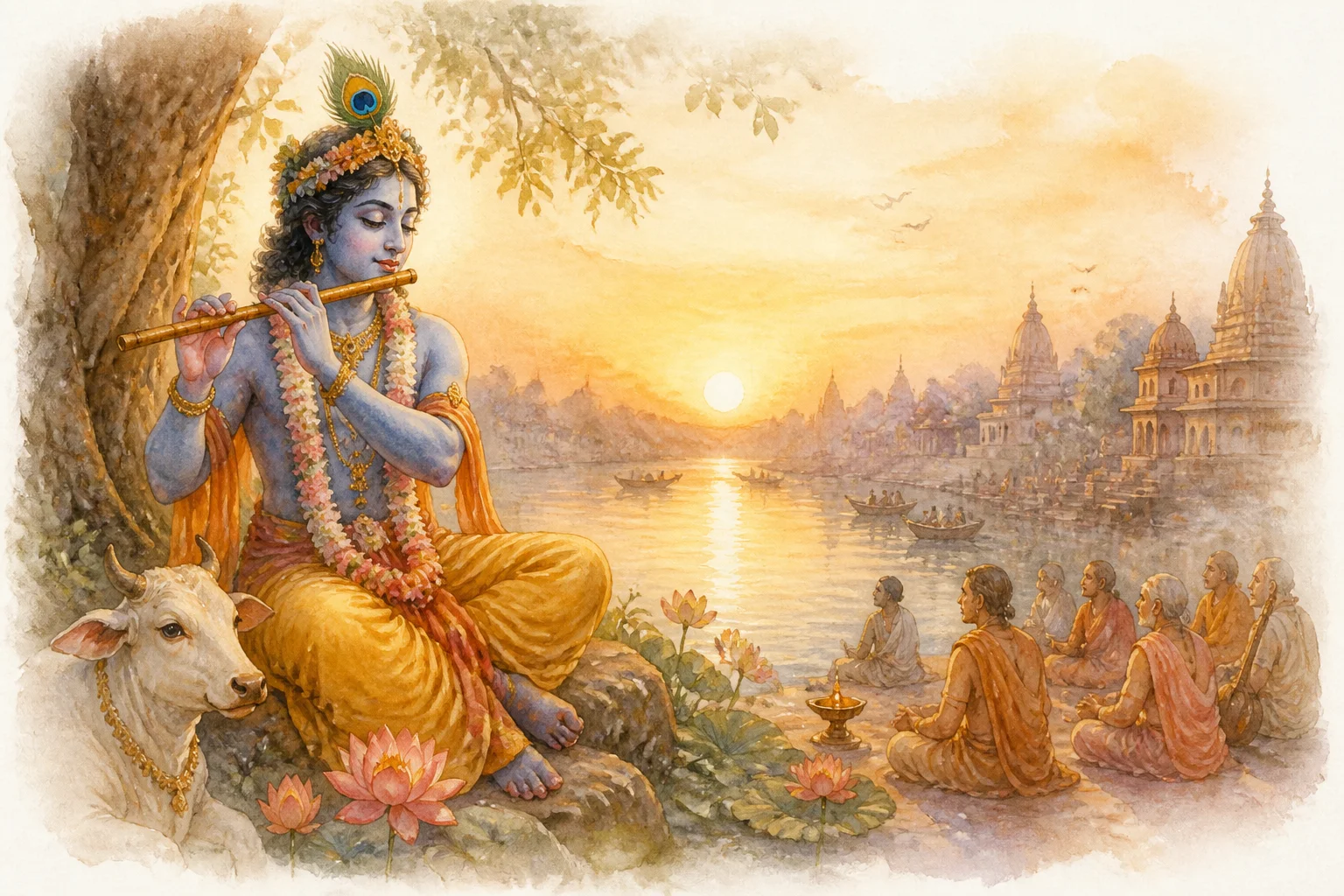
Complete · Morning chant · ~12 min · ~12 min chant
Bhaja Govindam
भज गोविन्दम्
Bhaja Govindam
A thirty-one-verse call to devotion, discrimination, and freedom from delusion, traditionally attributed to Adi Shankaracharya.
31 verses · About 12 min · Shri Vishnu
How do you want to read?
Chant one verse at a time, or open the full text to scroll the whole hymn.
Bhaja Govindam, also called Mohamudgara, is a 31-verse hymn traditionally attributed to Adi Shankaracharya. It calls the mind from worldly busyness toward Govinda. This edition gives Devanagari, IAST, English meaning, and Advaita study notes for daily recitation.
Bhaja Govindam is one of the most direct and memorable works traditionally attributed to Sri Adi Shankaracharya. Also known as Mohamudgara, “the hammer that shatters delusion,” it speaks in a deliberately urgent voice. Its famous refrain - “Worship Govinda, O bewildered mind” - is addressed not only to a grammarian in the traditional story, but to every tendency to mistake information, status, pleasure, or postponement for wisdom.
More about this stotra
The traditional thirty-one-verse recension moves through a wide field of human life: money, family attachment, youth and age, the instability of the body, ritual, renunciation, friendship, desire, anger, and meditation. Its sharp language should not be read as contempt for the world or for human relationships. Rather, it repeatedly asks what happens when limited things are asked to bear the weight of an unlimited longing. Wealth may serve life, family may be loved, and learning may be valuable; bondage begins when any of these becomes the final measure of the Self.
The word “Govinda” carries devotional warmth while also opening an Advaita horizon. The hymn does not present devotion and knowledge as rivals. Recollection of the divine steadies the mind, and a steadied mind becomes capable of *viveka*, discrimination between the lasting and the passing. The verses on *satsaṅga*, self-inquiry, and seeing one reality in all beings make this practical rather than merely doctrinal.
This edition follows a common thirty-one-verse core recension, sometimes circulated under the wider Charpaṭa-pañjarikā/Mohamudgara tradition. Later appended verses and refrains are not counted here. The editorial study notes are aids for reflection - not Shankara’s own commentary. Read the uncompromising images slowly: their intended force is to awaken responsible attention, compassion, and a freedom that can meet ordinary life without being owned by it.
At a glance
- Deity
- Shri Vishnu
- Verses
- 31 verses
- Chant time
- About 12 minutes (Morning chant · ~12 min)
- Attribution
- Traditionally attributed to Adi Shankaracharya
- Sanskrit source
- sanskritdocuments.org · All sources
- Also called
- Mohamudgara (Moha Mudgara); also spelled Bhaj Govindam
- When people chant
- Often in the morning, before study or work
- Guide
- Reading guide
Traditional context
Bhaja Govindam is widely chanted as a morning wake-up call for the spiritual life. Tradition links it to Shankaracharya encountering a scholar memorising grammar while neglecting prayer, and responding with the famous refrain: worship Govinda, for when the end comes, grammar will not save you.
The hymn belongs to the Vishnu collection because its refrain addresses Govinda, yet its tone is uncompromising Advaita life-wisdom rather than sentimental devotion alone. Many households and ashrams recite it before study or work.
Structure of this recension
This edition follows a common thirty-one-verse core recension associated with the Mohamudgara tradition. Each verse uses direct, often startling images to expose postponement, vanity, and misplaced security.
The refrain Bhaja Govindam returns throughout, gathering the scattered mind toward the Lord whose name alone is said to be the refuge at life's end.
How to read this edition
Sanskrit appears in Devanagari with optional IAST and regional-script transliteration in Reading settings. Each verse includes an editorial English study note from an Advaita-informed perspective.
These notes are reflections for contemplation, not Shankaracharya's own commentary or a traditional bhāṣya. Switch to Study mode in the reader to see them beside the chant.
Suggested practice
Begin with verse 1 for the refrain, then read one or two verses daily with the study note. Pair Bhaja Govindam with Nirvana Shatakam if you want devotion and self-inquiry together.
See the Bhaja Govindam reading guide for verse-by-verse orientation and FAQs.
Verse overview
- 1
The refrain redirects anxious learning toward remembrance of Govinda. When death nears, no amount of grammatical scholarship substitutes for devotion to the…
- 2
Craving for ever more wealth is opposed to contentment with what comes through one's own action. True peace arises when the mind rests in what is earned…
- 3
The verse interrupts objectifying fascination by recalling the body's impermanent materiality. Discrimination turns the gaze from surface attraction toward the…
- 4
Water on a lotus leaf becomes the image of precarious life amid illness, pride, and grief. Seeing the world's fragility loosens the grip of worldly attachment.
- 5
Conditional social affection is exposed by the decline of earning power and bodily strength. What seemed loyal devotion was often tied to utility, revealing…
- 6
The departing life-breath reveals the difference between a living person and a body treated as an object. What the world loved was the presence of…
- 7
Childhood, youth, and old age each have their absorption; Brahman is repeatedly postponed. Each life-stage offers its distraction while the one eternal aim…
- 8
Questions about kinship and origin become an invitation to investigate the Self. When relationships are seen as contingent, the seeker turns toward the…
- 9
Good company is traced as a practical sequence toward freedom while living. Each step - satsanga, detachment, clarity, steadiness - leads the mind from…
- 10
When supports vanish, the verse asks what remains once truth is known. Each worldly anchor dissolves in turn, leaving only the reality that survives every loss.
- 11
Time swiftly removes wealth, followers, and youth; knowledge points beyond their enchantment. Pride in passing gifts blinds the mind to the abiding Brahman…
- 12
Recurring days and seasons conceal the dwindling of life while hope continues to pull the mind. The calendar repeats but the lifespan does not; only awakening…
- 13
The companionship of the wise is offered as a boat across the ocean of becoming. When worldly supports fail, satsanga steadies the mind toward the shore of…
- 14
External ascetic costumes are questioned when they serve livelihood rather than insight. Outward renunciation without inner transformation is mere performance…
- 15
Physical old age does not itself release the knot of expectation. The body declines but the mind's clinging persists until true knowledge cuts the root of…
- 16
Even severe hardship and renunciation need not undo the rope of longing. Extreme austerity without Self-knowledge leaves the core of bondage untouched.
- 17
Pilgrimage, vows, and giving are insufficient when they are disconnected from liberating knowledge. Ritual merit without jnana cannot uproot the ignorance that…
- 18
Simplicity and letting go are praised for the happiness of dispassion. True vairagya frees the mind from the anxiety of acquisition and opens the heart to…
- 19
Joy belongs to the mind that delights in Brahman, regardless of outer lifestyle. External conditions change but the bliss of abiding in the Self is constant.
- 20
Even small, sincere contact with scripture, sacredness, and worship is valued over spiritual display. A single genuine turning toward the Lord outweighs a…
- 21
The repetition of birth and death becomes a direct cry for Mura's enemy, Vishnu, to save. Recognising the horror of samsara, the devotee surrenders to the Lord…
- 22
The yogin's freedom is portrayed as childlike and unconstrained by the ledger of merit and demerit. Liberation is not solemn austerity but spontaneous joy…
- 23
Self-inquiry questions inherited identity and compares worldly solidity to a dream. When the 'I' is traced to its source, the entire fabric of assumed…
- 24
Seeing one Vishnu in self and other becomes the basis for equanimity. Anger and intolerance arise from forgetting the single Self that shines in every form.
- 25
The instruction releases divisive fixation by seeing the Self in all relations. Friend and foe are alike appearances in the one consciousness; difference is…
- 26
Abandoning lust, anger, greed, and delusion opens the recognition 'I am That.' Without this knowledge the soul remains trapped in the inner hell of its own…
- 27
Singing, meditation, wise company, and generosity are integrated as a daily discipline. Devotional practice and ethical action together purify the mind for the…
- 28
The immediate pleasure of indulgence is contrasted with its bodily and ethical consequences. Knowing death is certain yet persisting in sin reveals the depth…
- 29
Wealth is examined as a source of anxiety as well as a means of support. The very things meant to bring security become grounds for fear, exposing the futility…
- 30
Breath discipline, sense-withdrawal, discrimination, recitation, and meditation demand sustained care. The classical aids to yoga require diligent practice…
- 31
Devotion to the guru and discipline of mind and senses reveal the deity dwelling in one's own heart. The Lord sought outside is found within when the inner…
All verses
Open full textRelated works
Common questions
- How many verses are in Bhaja Govindam?
- This edition presents 31 verses with Devanagari, IAST transliteration, English meaning, word breakdown, and editorial Advaita study notes.
- Does Bhaja Govindam include English meaning?
- Yes. Each verse includes an editorial English meaning and Advaita study note. Sanskrit is in Devanagari, with IAST and Telugu, Tamil, Malayalam, or Kannada transliteration in Reading settings. This edition does not include Hindi meanings.
- Can I read Bhaja Govindam in regional scripts?
- Yes. Use Reading settings or the reader toolbar to view the Sanskrit as Devanagari, IAST, Telugu, Tamil, Malayalam, or Kannada transliteration. Those views are script transliterations, not separate language translations.
- What is Bhaja Govindam also called?
- Bhaja Govindam is also known as Mohamudgara, the hymn said to shatter delusion. Search and recitation often use the spelling Bhaj Govindam for the same refrain calling the mind to worship Govinda.
- Which verse of Bhaja Govindam should I start with?
- Begin with verse 1 for the famous refrain, or open the work hub and choose Study mode to read each verse with commentary.