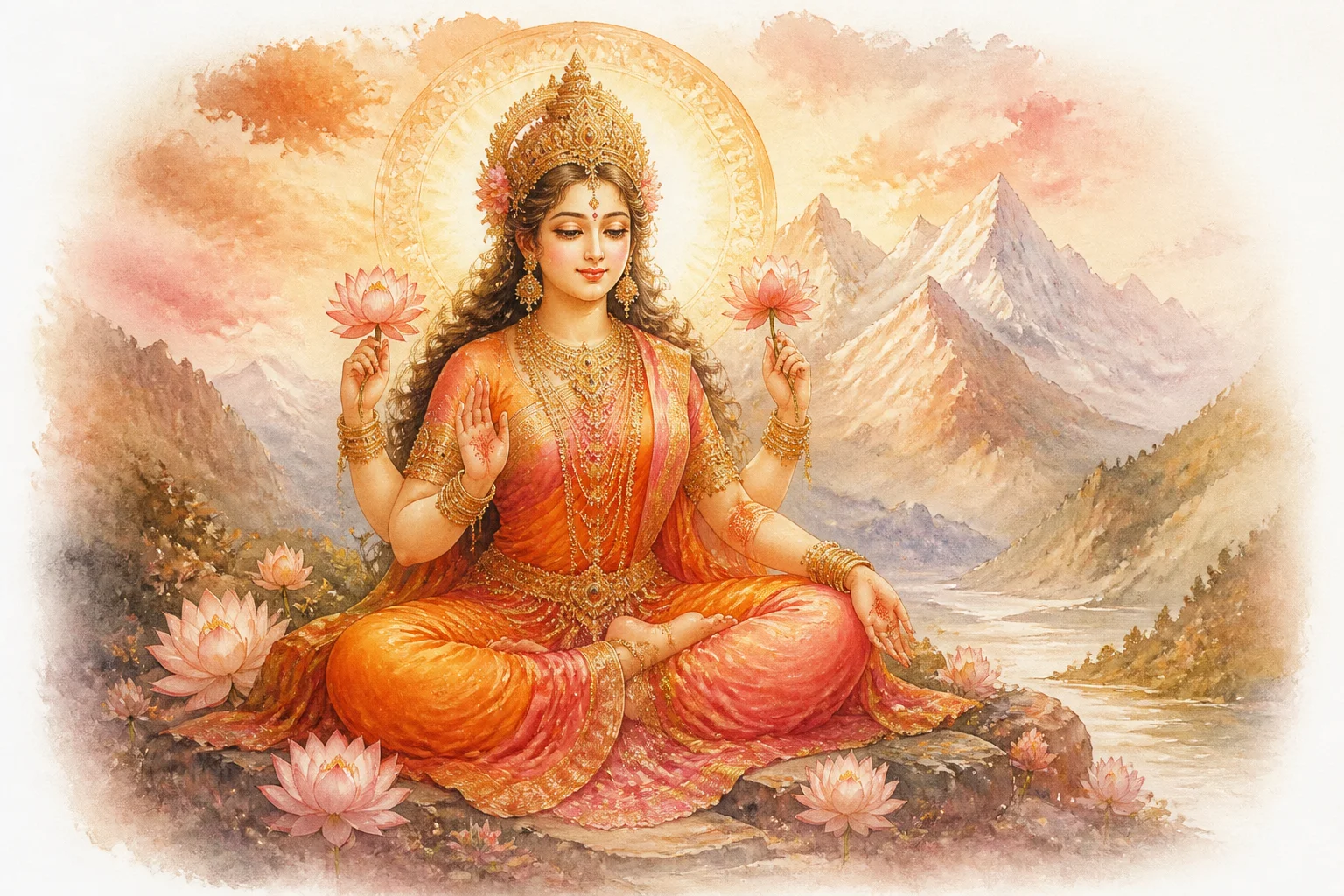
Complete · Divine Mother · ~80 min · ~80 min chant
Soundarya Lahari
सौन्दर्यलहरी
Saundaryalaharī
A hundred-verse hymn of devotion, contemplative imagery, and Śākta philosophy, traditionally attributed to Adi Shankaracharya.
100 verses · About 80 min · Shri Devi
How do you want to read?
Chant one verse at a time, or open the full text to scroll the whole hymn.
Soundarya Lahari is a 100-verse hymn to the Divine Mother, traditionally attributed to Adi Shankaracharya. It is a long-term chanting companion rather than a one-sitting recitation. This edition offers Devanagari, IAST, English meaning, and study notes.
Soundarya Lahari - "Wave of Beauty" - is a celebrated Sanskrit hymn traditionally attributed to Sri Adi Shankaracharya. Its hundred verses unite lyrical praise of the Divine Mother with a dense vocabulary of Śākta and yogic contemplation. The opening section is often called Ānandalaharī, the "Wave of Bliss"; standard recensions commonly place verses 1–41 under that title and verses 42–100 under Saundaryalaharī proper. As with many transmitted stotras, wording and verse divisions can vary slightly across editions.
More about this stotra
The hymn moves from the principle of Śakti through cosmic imagery, subtle-body contemplation, mantra and yantra symbolism, and finally an extended meditation on the beauty of the Divine Mother's form. The language is devotional and highly visual, but it also invites metaphysical reflection. In an Advaita-informed reading, Śakti need not be reduced to a mere secondary force: she is the intelligible, radiant power through which consciousness, world, worship, and liberation are known.
This edition presents the full hundred-verse recension for chanting and careful study. The editorial study notes are aids for reflection - not claims to be Shankara's own bhāṣya or instructions for tantric practice. Some verses employ specialized ritual and yogic symbolism; readers are welcome to appreciate the poetry while seeking qualified instruction for any formal sādhana.
Chant slowly, compare the Devanagari with the IAST, and let the imagery function as an invitation to attention rather than as material to rush through.
At a glance
- Deity
- Shri Devi
- Verses
- 100 verses
- Chant time
- About 80 minutes (Divine Mother · ~80 min)
- Attribution
- Traditionally attributed to Adi Shankaracharya
- Sanskrit source
- sanskritdocuments.org · All sources
- Also called
- The wave of beauty
- When people chant
- Sustained practice, often a few verses a day
- Guide
- Reading guide
Traditional context
Soundarya Lahari, the wave of beauty, is a hundred-verse hymn to the Divine Mother attributed to Shankaracharya. The first part (Ananda Lahari) emphasises Shakti as inseparable from Shiva; the latter verses turn to the beauty of the Goddess's form.
It is a long-term chanting companion rather than a single-session recitation.
Structure of this recension
One hundred verses move through philosophical opening, mantra and yantra imagery, subtle-body contemplations, and lyrical praise. Some verses employ specialised Sri Vidya symbolism.
This edition presents the full hundred-verse recension with editorial notes treating ritual imagery as poetry for reflection, not instructions for formal tantric practice.
How to read this edition
Read a few verses daily rather than attempting the full hymn at once. Study notes clarify Sanskrit images and offer contemplative Advaita readings where appropriate.
Suggested practice
Begin with verses 1-5 for the opening teaching on Shiva-Shakti inseparability. Use the Soundarya Lahari guide and Ananda Lahari edition for the first forty-one verses separately.
Verse overview
- 1
The opening verse presents Śiva and Śakti as inseparable: pure consciousness is not a second, inactive reality beside power, but is disclosed through its power…
- 2
A particle of dust from the Goddess's feet becomes a poetic measure of divine dependence: Brahmā creates with it, Viṣṇu bears it, and Śiva wears it as ash. The…
- 3
The verse piles up rescue-images - sunlight, nectar, jewel, and Varāha's tusk - to describe a single liberating presence. In Advaita study, these images can be…
- 4
The poem contrasts symbolic hand-gestures with the active refuge represented by the Goddess's feet. Editorially, the verse can be read as an invitation to let…
- 5
Mythic transformations here emphasize that beauty and desire are powers requiring discernment, not objects to be simplistically condemned. The study question…
- 6
Kāma's delicate equipment makes his victory paradoxical: apparently weak means are empowered by grace. For contemplation, the verse distinguishes raw…
- 7
This iconic visualization balances sensuous form with emblems of governance over mind and impulse: bow, arrows, noose, and goad. The devotional image is most…
- 8
The sumptuous inner landscape is a contemplative architecture, not simply a celestial travelogue. Its culmination in *cidānanda* lets the meditator read the…
- 9
This verse maps the elements through the yogic centres and pictures their transcendence in the sahasrāra. Such maps belong to a particular practice tradition;…
- 10
The descent of nectar and return to the coiled resting place portray a cyclic movement of manifestation and repose. A non-dual reading can hold both movements…
- 11
This verse presents an esoteric numerical mapping of tattvas (cosmic principles) to the triangular corners of the Goddess's feet, suggesting that her form…
- 12
Beauty here becomes a spiritual catalyst: even celestial women, moved by the desire to see the Goddess, attain through that very longing what is difficult to…
- 13
This verse depicts the transformative power of even a casual glance from the Goddess - it can make the aged, unattractive, and dull in conversation suddenly…
- 14
The verse enumerates the rays of light present in different elements and realms, only to declare that the Goddess's feet are above them all. This hierarchical…
- 15
Sarasvatī imagery here serves devotion to the Goddess as the source of inspired speech. The poet asks how sacred utterances sweet as honey, milk, and grapes…
- 16
The few saints who worship the dawn-red Goddess become themselves like the young sun illuminating the lotus-garden of poets' hearts. Their deep words, informed…
- 17
Whoever contemplates the Goddess alongside the speech-goddesses Vaśinī and others becomes a creator of great poetry. Their words become sweet with the…
- 18
Whoever remembers the entire universe - both heaven and earth - as suffused with the rosy radiance of the Goddess's subtle shadows finds that even celestial…
- 19
This verse describes a contemplative visualization of the Goddess as Ardhanārīśvara, with specific meditation points from face to heart. The practitioner who…
- 20
Whoever places the Goddess in his heart as a moonstone image radiating clusters of nectar-rays gains healing powers. Like Garuḍa subduing serpents, he humbles…
- 21
Great souls who behold the Goddess's power - slender as lightning yet comprising sun, moon, and cosmic fire - seated above even the six lotuses in the great…
- 22
The moment someone desires to pray 'Bhavānī, cast a compassionate glance on me, your servant' but only manages to say 'Bhavānī, You...', She immediately grants…
- 23
After taking Śiva's left half with an unsatisfied heart, the Goddess seems to have taken his other half as well, for her entire form appears rosy-red,…
- 24
While Brahmā creates, Viṣṇu protects, and Rudra destroys, Śiva - concealing even his own form - continuously bestows grace on all of this by depending on your…
- 25
Any worship offered to your feet becomes worship of the three gods born of the three guṇas - for they stand eternally near the jeweled platform that supports…
- 26
When Brahmā dissolves, Viṣṇu ceases, destruction itself is destroyed, and Kubera dies, even the vast expansion of Indra's realm closes its eyes. Yet in this…
- 27
Let all my activities - recitation, conversation, crafts, ritual gestures, walking, circumambulation, eating, offering, bowing, sitting, and all pleasure -…
- 28
Even after tasting nectar that removes fear, old age, and death, all celestial beings from Brahmā to Indra still perish. But the terrible roaring sound that…
- 29
Avoid Brahmā's crown in front, you stumble on the hard crown of Viṣṇu, destroy Indra's crown - such are the triumphant instructions of your attendants to Śiva…
- 30
Whoever constantly contemplates 'I am serving the eternal You' while surrounded by the radiant powers of aṇimā and others born from his own body - what wonder…
- 31
Though Śiva governs the entire universe through sixty-four tantras, each dependent on producing specific accomplishments, your tantra - arising from your own…
- 32
Śiva, Śakti, Kāma, Earth, Sun, Moon, Desire personified, Haṃsa, Indra, and then Parā, Aparā, and Para - these principles, formed with the three heart-lines at…
- 33
Some practitioners first establish Desire, Source, and Prosperity as a triad in your mind, then - as connoisseurs of unlimited great enjoyment with rosaries…
- 34
You are Śiva's body with breasts like sun and moon; I consider your Self to be his sinless new Self. Therefore the relationship of supporter and supported…
- 35
You are mind, space, wind, and wind's charioteer; you are water and earth. When you are thus transformed, there is nothing beyond you. You alone, in order to…
- 36
I salute the supreme Śiva who dwells in your command center, bearing the brilliance of millions of suns and moons, with you closely embraced at his side.…
- 37
In your viśuddha center I serve Śiva, clear as crystal and generating space, along with the Goddess whose resolve equals Śiva's. By their radiance moving in…
- 38
I worship the mysterious pair of swans that move in the minds of great souls, delighting only in the nectar of consciousness's blooming lotus. From their…
- 39
I praise the dissolution fire who continuously presides over fire in your svādhiṣṭhāna center, and that great covenant, O Mother - that when his gaze burns…
- 40
I serve your mysterious dark cloud that has lightning through Śakti's darkness-dispelling radiance, is girdled with Indra's bow flashing with various jeweled…
- 41
In your root center along with Samayā devoted to graceful dance, I consider the new Self to be the dancer of the great tāṇḍava of nine rasas. Pointing toward…
- 42
The poet imagines the Goddess's golden crown adorned with sapphires as so radiant that it outshines the moon itself. The verse asks why such supreme beauty…
- 43
The Goddess's hair is described as a dense, fragrant forest that can dispel darkness. The imagery suggests that flowers from Indra's garden dwell in her locks…
- 44
The central parting of the Goddess's hair, adorned with vermillion, is compared to a river channel carrying the flood of her facial beauty. The red sindur…
- 45
The Goddess's face, framed by naturally curved locks, surpasses even the lotus in beauty. When she smiles, revealing teeth bright as jasmine stamens, even the…
- 46
The pure radiance of the Goddess's forehead appears as a second crescent moon alongside the one adorning her crown. When both unite in reversed arrangement,…
- 47
The slightly arched eyebrows, dedicated to destroying the world's fears, appear as Kāma's bow strung with the bowstring of her bee-dark eyes. The poet suggests…
- 48
The Goddess's right eye creates day through its solar nature, her left eye creates the three watches of night through its lunar essence, and her third eye,…
- 49
The Goddess's glance is so expansive and auspicious that it deserves to be called by the names of great cities - Visala for its breadth, Ayodhya for being…
- 50
The ears are compared to young bees that exclusively relish the nectar of poetic works, but when they witness the Goddess's sidelong glances filled with the…
- 51
The Goddess's glance shows different emotions toward different beings: tender with Shiva, critical toward others, angry with Ganga, amazed at Shiva's stories,…
- 52
The eyes that extend to the ears with lashes like Garuda's wings have the power to dissolve the peace of even the city-destroyer Shiva's mind. O jewel of the…
- 53
Your three eyes shine with distinct colors mixed with dark collyrium, O beloved of Shiva. They appear like the three gunas - rajas, sattva, and tamas - ready…
- 54
To purify those whose hearts are surrendered to Pashupati, your compassionate eyes with their red, white, and dark colors bring together the confluence of…
- 55
Saints say that the world undergoes dissolution and creation through the closing and opening of your eyes, O daughter of the mountain king. Since this entire…
- 56
Frightened by the tale-bearing eyes that might report to your ear, small fish hide motionlessly in water. Meanwhile, Lakshmi abandons the lotus when its petals…
- 57
With your longer glance that has the radiance of split blue lotus petals, O Shiva, mercifully bathe even me, who am more pitiable and suffering. By this, I…
- 58
O daughter of the mountain king, whose curved eyelids do not arouse Cupid's flower-bow curiosity? Where the sideways extension of your corner glance, crossing…
- 59
I consider your face, with its radiant cheek-fullness reflecting the pair of earrings, to be Cupid's four-wheeled chariot. Mounting this, the great hero Māra…
- 60
As you drink Saraswati's wise sayings - waves of nectar that steal away skill - with your cupped ears continuously, your cluster of earrings moved by wonder…
- 61
That noble bridge of your nose, banner of the snow mountain's lineage, may it bear appropriate fruit for us. Carrying pearls inside formed by your cool breath…
- 62
I shall speak of similarity to your naturally red lip's brilliance, O fair-toothed one - may the coral creeper bear fruit. But not the bimba fruit, which has…
- 63
The cakora birds drinking the moonlight network of your face-moon's smile developed stiff beaks from the excessive sweetness. Therefore, your sour-bright rays…
- 64
Victorious is your tongue, O Mother, colored like the japa flower, ceaselessly engaged in muttering praise of your husband's qualities. When Saraswati's…
- 65
Having conquered demons in battle with their severed heads as weapons, the armored gods including Vishakha, Indra, and Upendra return, averse to the fierce sun…
- 66
When you begin singing Pashupati's various stories on the vina with nodding head in good speech, Vani (Saraswati) quietly covers her own vina with her garment,…
- 67
Touched by the snow mountain's fingertip with affection and lifted by Girisha repeatedly in eagerness to drink from your lips - O daughter of the mountain, how…
- 68
Your neck, made tender from the constant embrace of the city-destroyer's arms, bears the beauty of being your face-lotus's stem. Naturally white but darkened…
- 69
Three lines shine on your neck, skilled in movement and song, reflecting the bound three-fold qualities of marriage. They appear like the boundary regulations…
- 70
Lotus-born Brahma praises the beauty of your four lotus-soft arm-vines with his four faces. Frightened by your nails from the first churning when you destroyed…
- 71
The verse presents an aesthetic challenge: how to describe hands whose nail-glow surpasses the lotus's natural beauty. The comparison with Lakshmi's…
- 72
The maternal scene where Ganesha touches his own temples in wonder at the Goddess's beauty creates both humor and devotional intimacy. The verse suggests that…
- 73
The verse affirms that Skanda and Ganesha, though mighty warriors, remain eternally innocent, sustained by divine nectar rather than worldly experience. This…
- 74
The pearl necklace becomes a symbol of fame mixed with power, where natural beauty (pearls from Airavata) combines with divine radiance. The imagery suggests…
- 75
This verse likely refers to a great South Indian poet who, having received the Goddess's grace, became eloquent in Sanskrit poetry. The image of divine milk as…
- 76
When Kamadeva was burned by Shiva's third eye, he sought refuge in the Goddess's navel and emerged as the fine body hair adorning her. This mythic…
- 77
The Goddess's slender waist resembles the Yamuna's gentle waves, formed as space between her breasts seems compressed into the navel's hollow. This anatomical…
- 78
The navel becomes a cosmic center - Ganga's whirlpool, Kama's sacrificial fire altar, and the gateway to spiritual attainment. Multiple symbolic layers suggest…
- 79
The poet expresses tender concern for the Goddess's slender waist, fearing it might break under the weight of her full breasts. This hyperbolic worry creates…
- 80
Nature itself seems to worry about the Goddess's delicate frame, providing three protective folds at her waist like vine-bindings. This personification of…
- 81
Himalaya, as Parvati's father, transferred his own mass and breadth to her hips, making the entire earth seem light by comparison. This mythic explanation for…
- 82
The Goddess's thighs surpass elephant trunks and golden plantain stems in beauty, while her knees, made strong by devotional prostrations to Shiva, rival…
- 83
The Goddess's legs become Kama's reinforced quivers to defeat Rudra, with her toenails as arrow-points sharpened on gods' crowns. This militaristic beauty…
- 84
The Vedas themselves crown their heads with the Goddess's feet, whose washing water becomes the Ganga in Shiva's hair and whose lac-beauty rivals divine…
- 85
Shiva becomes jealous of the Goddess's beautiful lac-reddened feet and desires to strike them, like a lover playfully competing for attention in garden sports.…
- 86
The Goddess playfully kicks Shiva's forehead when he feigns shame over genealogical errors, causing the ankle bells given by Kama's killer to tinkle. This…
- 87
The Goddess's lotus feet paradoxically destroy snow while dwelling on snowy peaks, bloom at night while being clear in late night, and surpass Lakshmi in…
- 88
The poet wonders how the Goddess's feet, which are the source of fame and destroyer of troubles, were compared by saints to hard tortoise shells, and how Shiva…
- 89
The Goddess's toenails outshine even the moon-crescents formed by celestial women's closing lotus-hands. While celestial beings give fruits from tender…
- 90
The Goddess continuously gives wealth matching the poor's hopes while scattering beauty's nectar. The devotee prays to become like a bee with six feet (senses…
- 91
Palace swans, as if learning dance steps, follow the Goddess's movements and won't leave her play. Their training comes through the pretext of her musical…
- 92
Brahmā, Viṣṇu, Rudra, and Īśvara have become the legs of the Goddess's bed, while Śiva serves as the mattress woven from crystal-clear shadow. His body,…
- 93
The Goddess displays varied qualities - curly hair, naturally simple gentle smile, śirīṣa-soft heart, crystal-hard breast beauty, very slender waist, and full…
- 94
As Śiva's inner consort, proper worship of the Goddess's feet is difficult for those with restless minds. The gods, led by Indra, achieved matchless perfection…
- 95
The moon's dark spot is musk, its disc is made of water, filled with camphor crescents in an emerald container. Daily, through the Goddess's enjoyment, Brahma…
- 96
Many poets have Brahmā-given wives, many become Lakṣmī's husband through some wealth, but even leaving Mahādeva, contact with your breasts is difficult even…
- 97
Scripture experts name four goddesses: Sarasvatī (speech), Brahmā's wife, Lakṣmī (Viṣṇu's consort), and Pārvatī (Śiva's companion). But you are some fourth…
- 98
The devotee-student asks when he may drink the lac-sweetened water that washes the Goddess's feet, and when even the naturally mute will receive the…
- 99
Your devotee sports as co-husband with Saraswati and Lakshmi alongside Brahma and Vishnu, loosens even Rati's chaste devotion with his beautiful form, and…
- 100
This hymn to you, O Mother of Speech, is like: waving lamps before the sun, offering moon-stone water to the moon, or sweetening the ocean with its own waters…
All verses
Open full textRelated works
Common questions
- When do people recite Soundarya Lahari?
- Devi hymns are widely recited on Fridays, during Navaratri, and as morning Mother-worship. This edition is labeled for practice as "Divine Mother · ~80 min" and takes about 80 minutes to chant.
- What is the opening focus of Soundarya Lahari?
- The opening verse presents Śiva and Śakti as inseparable: pure consciousness is not a second, inactive reality beside power, but is disclosed through its power of manifestation. Read as a study note rather than a metaphysical slogan, it asks devotion to recognize the source from which both worshipper and worship arise. Read verse 1 in Study mode for the full editorial note beside the Sanskrit.
- Which hymns pair well with Soundarya Lahari?
- On this site, related reading includes Kanakadhara Stotram, Ananda Lahari, and Nirvana Shatakam. Open those hubs for their own Sanskrit, English meaning, and study notes.