Complete · Lakshmi prayer · ~10 min · ~10 min chant
Kanakadhara Stotram
कनकधारा स्तोत्रम्
Kanakadhārā Stotram
Twenty-one verses invoking Lakṣmī’s compassionate abundance, traditionally attributed to Adi Shankaracharya.
21 verses · About 10 min · Shri Devi
How do you want to read?
Chant one verse at a time, or open the full text to scroll the whole hymn.
Kanakadhara Stotram, also spelled Kanakdhara, is a 21-verse hymn to Goddess Lakshmi, traditionally attributed to Adi Shankaracharya. Devotees recite it for compassion and provision. This reader presents Sanskrit, English meaning, and study notes verse by verse.
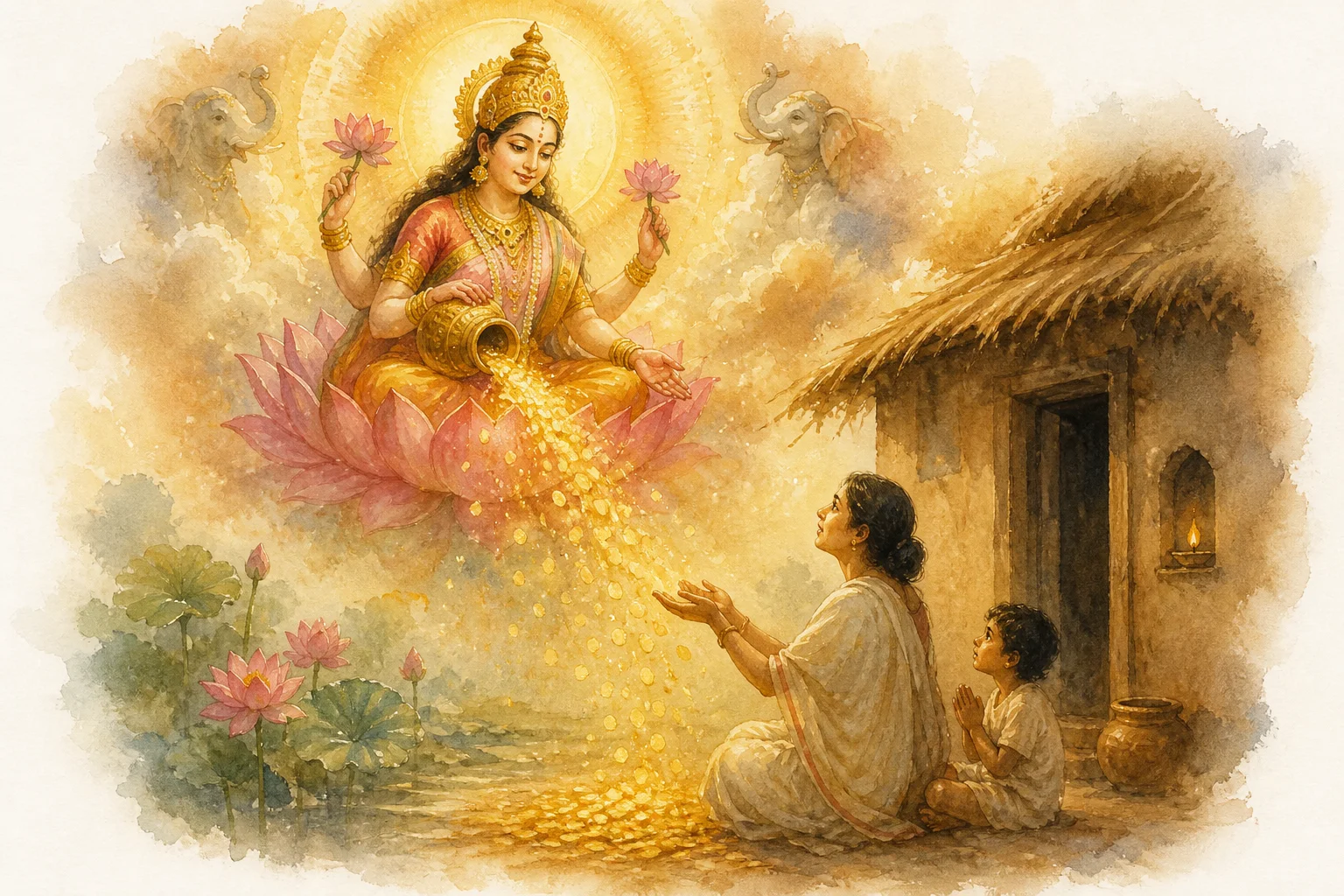
Kanakadhārā Stotram, the “Hymn of the Golden Stream,” is a beloved praise-poem to Śrī Lakṣmī traditionally attributed to Sri Adi Shankaracharya. Its title evokes the famous later legend in which a poor woman’s selfless offering moves the young Shankara to pray, and Lakṣmī answers with a shower of golden āmalakas. The story is devotional tradition rather than a historical biography, yet it gives the poem a powerful ethical setting: generosity can appear precisely where material resources are scarce.
More about this stotra
The hymn’s poetic centre is Lakṣmī’s *apāṅga*, her sidelong glance. That glance is described through bees, lotuses, lightning, blue jewels, rain clouds, and the ocean of milk. These are not merely ornamental comparisons. They show prosperity as something relational and radiant: it belongs to beauty, nourishment, mercy, and the capacity to bless, not only to possession.
Kanakadhārā also speaks candidly of poverty, fear, harmful karma, and longing for support. Its requests for wealth should therefore be read with care. In a life-wisdom register, “wealth” can include livelihood, stability, hospitality, learning, and the inward ease that makes generosity possible. The stotra does not offer a transaction in which recitation guarantees money; its deeper devotional grammar is humility, gratitude, and dependence on grace.
The accompanying editorial study notes are reflections for contemplation, not a replacement for a traditional commentary or a claim to state Shankara’s own interpretation. As you recite, attend to how the poem joins reverence for Lakṣmī with the responsibility to use whatever abundance comes well.
At a glance
- Deity
- Shri Devi
- Verses
- 21 verses
- Chant time
- About 10 minutes (Lakshmi prayer · ~10 min)
- Attribution
- Traditionally attributed to Adi Shankaracharya
- Sanskrit source
- sanskritdocuments.org · All sources
- Also spelled
- Kanakdhara
- Deity praised
- Lakshmi (Shri Devi)
- When people chant
- Morning recitation, often on Fridays
- Guide
- Reading guide
Traditional context
Kanakadhara Stotram is beloved as the hymn through which Shankaracharya is said to have invoked Lakshmi's compassion for a poor household. The golden shower of kanaka-dhara imagery has made it one of the most recited Devi stotras in South India.
Devotees often chant it on Fridays, in the morning, or when praying for dignified provision rather than mere luxury.
Structure of this recension
Twenty-one verses praise Lakshmi in luminous detail: lotus, golden hue, conch and discus, compassion for the distressed, and sovereignty over fortune itself.
The poem moves from reverent description toward surrender, asking the Goddess to turn her glance toward the devotee with the same grace shown to the gods.
How to read this edition
Each verse includes line breakdown where available, editorial English meaning, and an Advaita study note treating abundance as dignity and responsibility, not mechanical reward for recitation.
Transliteration views are script conversions of the Sanskrit, not separate translations.
Suggested practice
Recite slowly, attending to how the hymn joins reverence for Lakshmi with the call to use whatever comes well. Follow with the Kanakadhara reading guide for traditional context.
Verse overview
- 1
Lakshmi's sidelong glance adorns Vishnu as the auspicious tremor of devotion. When the mind sees grace as inseparable from the Lord, abundance is recognized as…
- 2
The shy, returning glance is the play of consciousness delighting in its own reflection. Prosperity sought from Lakshmi is ultimately the inward wealth of joy…
- 3
Half-closed eyes express absorbed love, the mind neither fully outward nor withdrawn. Bliss is the ground of being; when attention turns to the Lord within,…
- 4
Her glances on Vishnu's chest show that even the supreme Lord's fulfilment flows from the divine feminine power. Welfare arises when devotion recognizes the…
- 5
Lightning on the rain-cloud images grace flashing on the dark ground of the Lord. The Mother of worlds is the power through which the one consciousness appears…
- 6
The glance that empowered Kāma shows divine power behind even desire. The devotee asks that the same gracious attention turn inward, melting the ego's…
- 7
Her glance dignifies even the gods and delights Vishnu, showing that bliss exceeds every object. A moment of true seeing reveals the Self as the source of…
- 8
Compassion makes even heavenly attainment accessible, yet the devotee seeks nourishing fullness of being. True puṣṭi is the growth of consciousness into its…
- 9
The famous plea asks the rain-cloud eyes to cool the heat of karma. When the mind admits its helplessness, grace flows as naturally as rain, dissolving the…
- 10
Many names converge in one power present through creation, preservation, and dissolution. The Goddess as Guru's consort points to śakti as the living teaching…
- 11
She is praised as revelation, delight, power, nourishment, and Viṣṇu's beloved. These are not separate goddesses but aspects of the one śakti through which the…
- 12
Beauty, cosmic origin, and union with the Lord are one in Lakshmi. Birth from the milk-ocean symbolizes consciousness emerging from the undivided absolute yet…
- 13
Golden lotus, earthly sovereignty, and divine mercy describe the one Goddess who rules manifestation. Her favour extends even to the gods because she is the…
- 14
Lineage, lotus-home, and place on Viṣṇu's heart unite in one salutation. To honor her on the Lord's chest is to see the non-duality of being and its…
- 15
Radiance, world-generativity, and worship by the gods gather in one litany. She who mothers the worlds is the creative aspect of consciousness itself, not a…
- 16
The poet asks that salutation itself become the discipline that removes harm and matures prosperity. When worship unites word, sense, and intent, every act of…
- 17
Wholehearted worship through glance, word, and mind integrates the devotee's being. The Goddess as sovereign of Vishnu's heart is the inward ruler in whom all…
- 18
The direct prayer addresses Lakshmi as beauty and world-welfare in one form. Grace from the divine feminine is the recognition that the Self alone is the…
- 19
Morning abhiṣeka by the directional elephants images the cosmos honouring its source. She who is mother, consort, and ocean-born daughter is the one…
- 20
Poverty offered without pretence becomes the fit vessel for compassion. The destitute devotee discovers that emptiness of ego is precisely what opens the heart…
- 21
The closing prayer seeks a daily compassionate gaze upon a heart troubled by lack and fear. Refuge in the world-mother is the turning of attention to the Self…
All verses
Open full textRelated works
Common questions
- Who composed Kanakadhara Stotram?
- Kanakadhara Stotram is traditionally attributed to Adi Shankaracharya. The site presents a working recension with editorial study notes and does not claim to settle every historical authorship question.
- How many verses are in Kanakadhara Stotram?
- This edition presents 21 verses with Devanagari, IAST transliteration, English meaning, word breakdown, and editorial Advaita study notes.
- Does Kanakadhara Stotram include English meaning?
- Yes. Each verse includes an editorial English meaning and Advaita study note. Sanskrit is in Devanagari, with IAST and Telugu, Tamil, Malayalam, or Kannada transliteration in Reading settings. This edition does not include Hindi meanings.
- Can I read Kanakadhara Stotram in regional scripts?
- Yes. Use Reading settings or the reader toolbar to view the Sanskrit as Devanagari, IAST, Telugu, Tamil, Malayalam, or Kannada transliteration. Those views are script transliterations, not separate language translations.
- Is Kanakdhara the same as Kanakadhara Stotram?
- Yes. Kanakdhara is a common spelling of Kanakadhara Stotram, the hymn to Goddess Lakshmi. Both names refer to this 21-verse edition.
- When should I chant Kanakadhara Stotram?
- Devotees often recite it in the morning or on Fridays, especially when seeking Lakshmi's grace. Read the guide for context on its traditional origin story.