Complete · ~35 min chant
Ananda Lahari
आनन्दलहरी
Ānandalaharī
The first forty-one verses of the Soundarya Lahari cycle, the Wave of Bliss to the Divine Mother.
41 verses · About 35 min · Shri Devi
How do you want to read?
Chant one verse at a time, or open the full text to scroll the whole hymn.
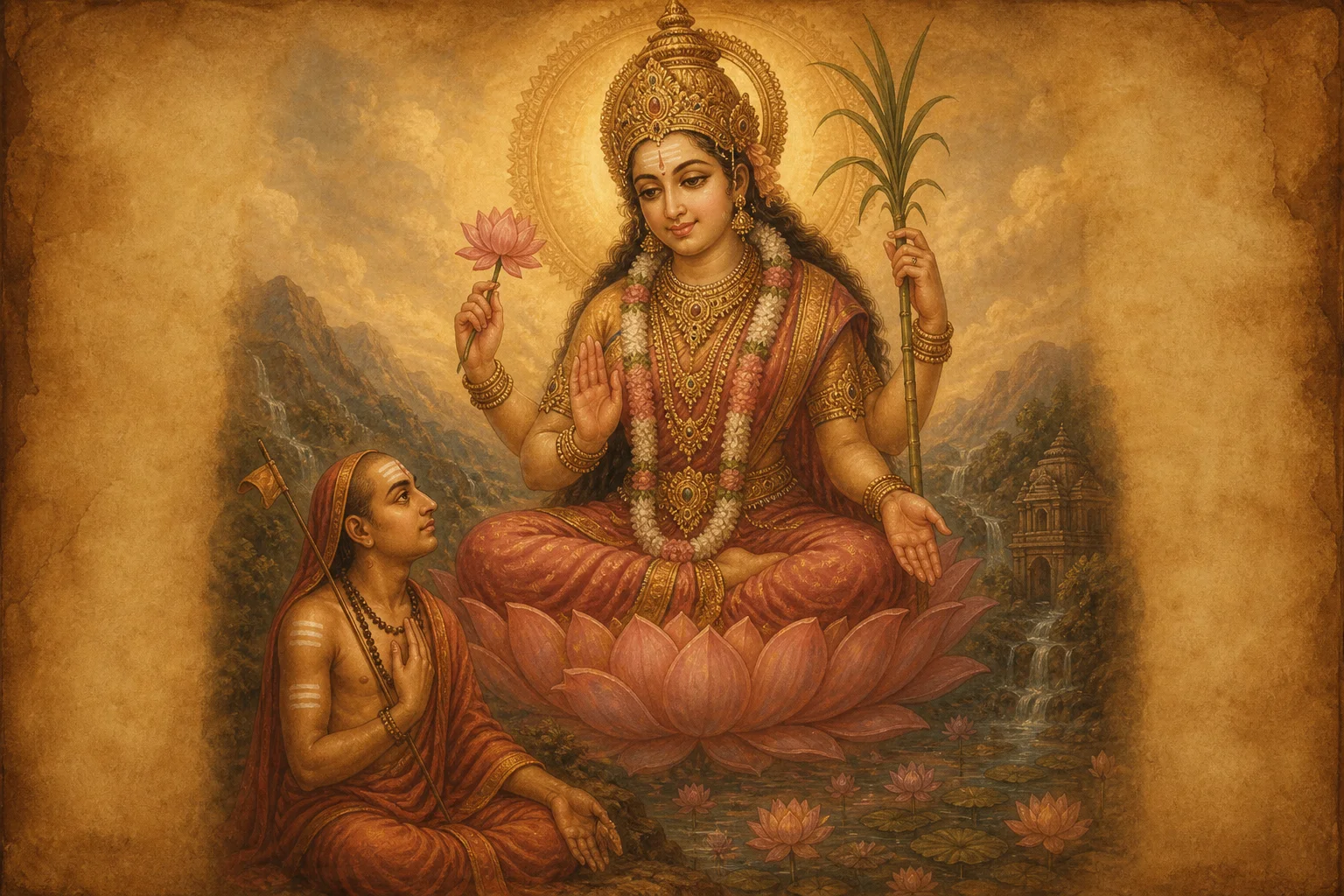
Ananda Lahari (Wave of Bliss) is the title traditionally given to the first forty-one verses of the Soundarya Lahari hymn attributed to Sri Adi Shankaracharya. These verses praise the dynamic aspect of Shakti: the inseparability of Shiva and Shakti, the cosmic dependence of Brahma and Vishnu on the Goddess's grace, and the subtle-body contemplations that map the elements through the yogic centres.
More about this stotra
The Ananda Lahari moves from philosophical opening through mantra, yantra, and mandala imagery before the Saundaryalahari proper turns to the beauty of the Divine Mother's form. This edition presents all forty-one verses with the same curated editorial notes used in the full Soundarya Lahari edition, and cross-links to the complete hundred-verse work.
At a glance
- Deity
- Shri Devi
- Verses
- 41 verses
- Chant time
- About 35 minutes
- Attribution
- Traditionally attributed to Adi Shankaracharya
- Sanskrit source
- sanskritdocuments.org · All sources
Verse overview
- 1
Consciousness without power cannot manifest; Shiva and Shakti are not two realities but one. Worship itself becomes possible only when the devotee recognizes…
- 2
Even the gods depend on a speck of the Goddess's grace. Cosmic offices are secondary to the ground of surrender; humility before Shakti is the Advaitin's…
- 3
The Goddess is described as rescue in every condition: light for ignorance, nectar for dullness, wealth for poverty, and uplift for those drowning in samsara.…
- 4
Symbolic gestures of protection are surpassed by active refuge at the Goddess's feet. Surrender at the source of being transforms fear into the courage that…
- 5
Even Vishnu and Kama are transformed by devotion to the Goddess. Beauty and desire are powers requiring discernment; when seen as expressions of Shakti,…
- 6
Kama's delicate weapons gain victory only through the Goddess's grace. Desire empowered by divine compassion turns toward beauty and relationship rather than…
- 7
The Goddess embodies both beauty and sovereign control over mind and impulse. Contemplating Her form trains the devotee to see aesthetic delight and spiritual…
- 8
The inner palace culminates in cidānanda, consciousness-bliss. The sumptuous landscape is a contemplative architecture whose true substance is the radiance of…
- 9
The elements mapped through the yogic centres are transcended in the sahasrara. The union of Shiva and Shakti at the crown symbolizes the non-dual recognition…
- 10
Nectar descending and return to the coiled resting place portray manifestation and repose as one cycle. In Advaita, both outward creation and inward withdrawal…
- 11
The esoteric numerology maps all tattvas to the Goddess's feet. She encompasses every category of manifestation; devotion discovers in Her form the formal…
- 12
Beauty becomes a spiritual catalyst: longing to behold the Goddess can surpass austere effort. When aesthetic appreciation recognizes its true object, it opens…
- 13
Even a casual glance from the Goddess transfigures ordinary perception. Grace can remake the seer so that the world reflects the beauty of the one…
- 14
The rays enumerated in each element and realm are surpassed by the Goddess's feet. Devotion to Her transcends systematic knowledge of cosmic categories,…
- 15
Inspired speech arises only after bowing to the Goddess as source of the word. The creative power of language flows from surrender to the Self in its feminine…
- 16
Those who worship the dawn-red Goddess become themselves sources of inspired expression. Authentic realization naturally flowers into words that delight the…
- 17
Meditation on the Goddess with the powers of speech makes one a creator of inspired poetry. The sacred source of all authentic expression is the non-dual…
- 18
Seeing the universe suffused with the Goddess's radiance transforms one's relation to all beauty. When the world is recognized as Her manifestation, attraction…
- 19
The geometric meditation on Ardhanārīśvara integrates form, desire and cosmic power. Shiva and Shakti as one body symbolize the non-dual Self in which…
- 20
Meditation on the Goddess as cool nectar-ray dispels the heat of affliction. The healing glance is the compassion of awareness itself, which soothes the fever…
- 21
The Goddess as lightning-art above the six centres is seen when illusion's stain is washed away. Great souls experience the wave of supreme bliss when the mind…
- 22
Calling on the Goddess as Bhavani opens the path of union with Her. The name itself is grace; in Advaita, the devotee who turns inward discovers that the…
- 23
The poet reads the Goddess's rosy form as evidence that She took more than half of Shiva. Ardhanārīśvara expresses the truth that pure consciousness and its…
- 24
The cosmic functions of creation, preservation and dissolution move at the Goddess's glance. The one Shiva-Shakti is the source of all divine activity; the…
- 25
Worship of the trimurti is ultimately worship of the Goddess's feet. All deities and gunas resolve in the one source; the trimurti bowing at Her throne…
- 26
While all gods perish at the cosmic dissolution, Shiva sports with the Goddess. The eternal Lord untouched by universal destruction is pure consciousness…
- 27
Every act offered with the vision of self-surrender becomes worship. When all movements of body, speech and mind are seen as offerings to the Goddess, daily…
- 28
Even immortals who taste divine nectar are subject to time's lord, except through the Mother's power. Her earring's glory surpasses Shiva's; the feminine…
- 29
The crowns of gods are obstacles before the Goddess's feet where Shiva rises. True devotion leaves behind even celestial rank; the word of Her attendants…
- 30
Identity with the Goddess through the eight powers makes even Shiva's glory seem slight. The sage for whom the cosmic fire itself performs worship has…
- 31
Shiva's many tantras yield particular powers, but the Goddess's single tantra unites all aims. The non-dual path transcends every partial system, for the one…
- 32
The letters of the heart-cave spell the names of gods and elements as the Goddess's own body. All manifestations are letters of the one name; the cosmos is the…
- 33
The triad of desire, source and prosperity held in the Goddess's mind is worshipped through fire-offering. The eternal enjoyers of boundless bliss are those…
- 34
Shiva's body and the Goddess's Self are one through shared essence. The relation of Lord and sovereign is the non-dual truth that consciousness and bliss are…
- 35
Every element and the mind itself are the Goddess; nothing remains outside Her. The universe is Her own Self-assumption as cidānanda; in Advaita, the world is…
- 36
Shiva enthroned in the Goddess's command-wheel dwells beyond sun and moon. The supreme Lord embraced by pure consciousness abides in the lightless light that…
- 37
Shiva and the Goddess of equal resolve shine with crystal purity. Their radiance makes sun and moon alike and dispels inner darkness; the world awakened to…
- 38
The swan-pair of Shiva and Shakti dwell in the lotus of consciousness. Their dialogue begets the fullness of knowledge; even apparent fault becomes merit, for…
- 39
The fire at the svadhisthana and the Samaya Goddess are one power of destruction and cooling grace. The same awareness that burns illusion with wrathful glance…
- 40
The dark cloud at manipura rains nectar on worlds scorched by sun and fire. Shakti as lightning-flash dispels inner darkness; the cooling rain is grace that…
- 41
At the muladhara the Goddess dances the nine rasas with Her Lord, and from their compassionate union the world is born. Creation is the play of Shiva and…
All verses
Open full textRelated works
Common questions
- When do people recite Ananda Lahari?
- Devi hymns are widely recited on Fridays, during Navaratri, and as morning Mother-worship. This edition presents 41 verses and takes about 35 minutes to chant.
- What is the opening focus of Ananda Lahari?
- Consciousness without power cannot manifest; Shiva and Shakti are not two realities but one. Worship itself becomes possible only when the devotee recognizes the source from which both seeker and sought arise. Read verse 1 in Study mode for the full editorial note beside the Sanskrit.
- Which hymns pair well with Ananda Lahari?
- On this site, related reading includes Soundarya Lahari. Open those hubs for their own Sanskrit, English meaning, and study notes.