Complete · ~5 min chant
Dakshinamurti Ashtakam
दक्षिणामूर्ति अष्टकम्
Dakṣiṇāmūrti Aṣṭakam
Eight foundational verses on the silent Guru who reveals the Self as the one reality behind the mirrored universe.
8 verses · About 5 min · Guru and Dakshinamurti
How do you want to read?
New here? Read the full text first, or go verse by verse to chant.
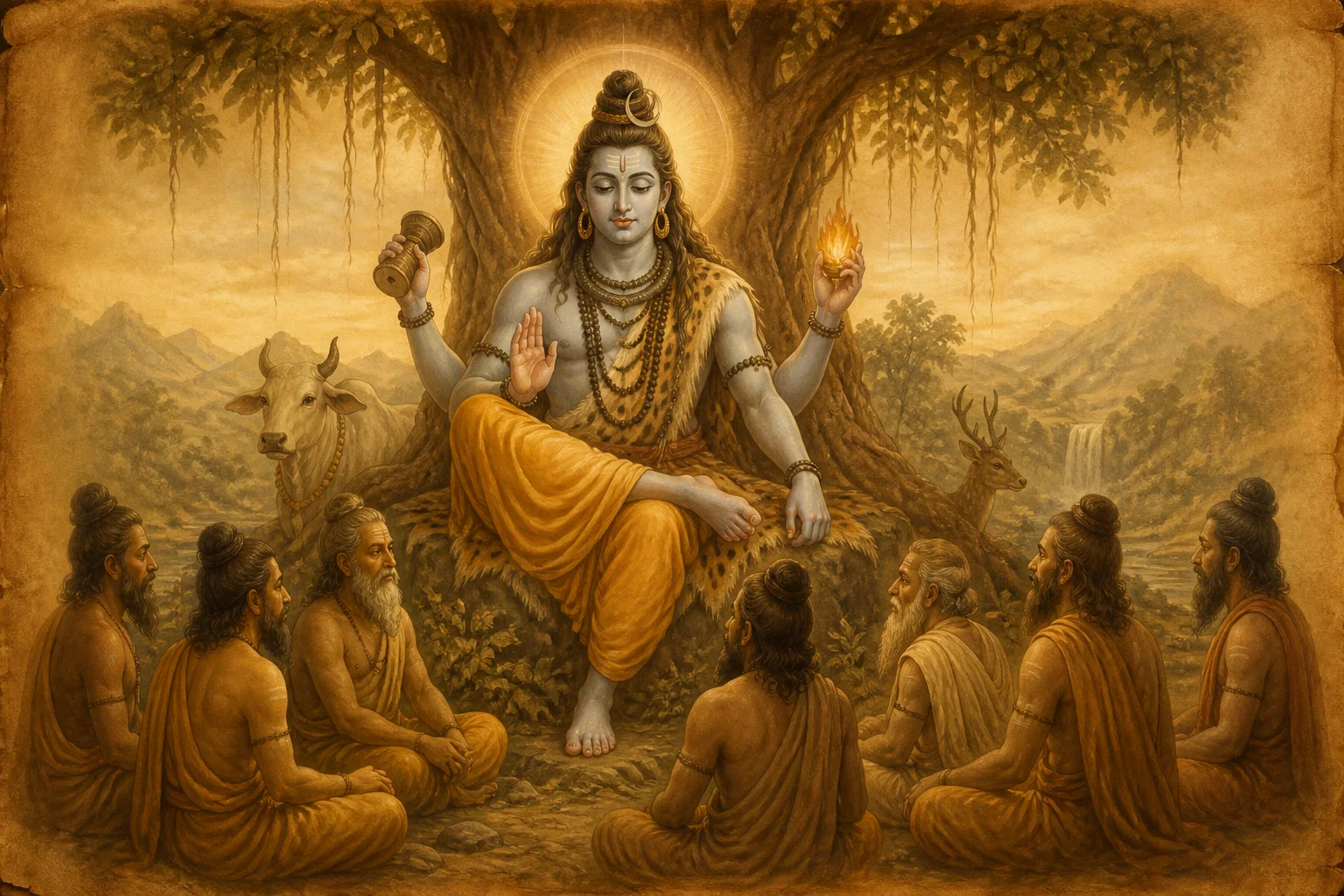
Dakshinamurti Ashtakam is the core eight-verse hymn to Shiva as the silent guru facing south beneath the banyan tree. Traditionally attributed to Adi Shankaracharya, it is distinct from the fuller Dakshinamurti Stotram on this site. Read it with Sanskrit, English meaning, and Advaita study notes.
Dakshinamurti Ashtakam is the core eight-verse hymn traditionally attributed to Sri Adi Shankaracharya in praise of Dakshinamurti, Shiva as the supreme teacher facing south beneath the banyan tree. Each verse closes with salutation to the Guru-murti, linking outer devotion to the inner teacher who grants direct recognition of the Self.
More about this stotra
The stotra is among the most studied texts in Advaita Vedanta. Shankara compares the world to a city seen in a mirror, teaches the unfolding of manifestation from the unmanifest like a seed, and repeatedly returns to the one consciousness that illumines waking, dream, and deep sleep. The verses are not abstract doctrine alone; they invite the reader to notice how perception, memory, and relationship are projected, then to rest in what does not come and go.
This edition presents the eight-verse ashtakam proper, without the ninth verse on the eight elemental forms or the tenth phala shruti found in the fuller Dakshinamurti Stotram. Verse one includes an optional pada breakdown for study; other verses use line-level editorial notes generated from the source text.
At a glance
- Verses
- 8 verses
- Chant time
- About 5 minutes
- Attribution
- Traditionally attributed to Adi Shankaracharya
- Sanskrit source
- sanskritdocuments.org · All sources
- Guide
- Reading guide
Traditional context
Dakshinamurti Ashtakam praises Shiva as the silent teacher facing south beneath the banyan tree. It is among the most studied short hymns in Advaita Vedanta, linking outer iconography to the inner guru who grants recognition of the Self.
Temples and ashrams recite it during Guru Purnima and study sessions. It is the compact sibling of the fuller Dakshinamurti Stotram.
Structure of this recension
Eight verses close with salutation to the Guru-murti. Imagery includes the world as a city seen in a mirror and manifestation unfolding from the unmanifest like a seed.
This edition presents the ashtakam proper, without the ninth verse on the eight elemental forms or the tenth phala shruti found in the extended stotram.
How to read this edition
Philosophy notes highlight Vedantic themes without claiming to be Shankara's own bhashya. Use Study mode for English exposition after chanting.
Transliteration views convert the same Sanskrit into regional scripts; they are not separate translations.
Suggested practice
Memorise the eight verses as a short morning inquiry, then read one study note slowly. For the extended text, open Dakshinamurti Stotram. Pair with Gurvashtakam on Guru Purnima.
Verse overview
- 1
The world appears outside through maya yet abides within like a reflection in a mirror. Awakening is the direct recognition that the non-dual Self alone is…
- 2
The universe unmanifest in the seed-state unfolds through maya's play of time and space. The Lord who projects it at will is the same consciousness that…
- 3
The light of the Self makes the unreal seem real until the Guru teaches tat tvam asi. Direct knowledge of identity with Brahman ends rebirth in the ocean of…
- 4
Consciousness shines through the senses like light through holes in a pot, yet itself is not confined. The 'I know' that illumines all experience is the Self…
- 5
Those who mistake body, breath, mind, or void for the Self remain caught in maya's great delusion. The Guru cuts that confusion and points to the witness…
- 6
In deep sleep the Self persists as pure being while maya veils it like an eclipse. Waking recalls that prior state, showing the continuity of the witness…
- 7
The inner 'I' persists unchanged through childhood, waking, dream, and sleep. The Guru's jnana mudra makes manifest the Self that was never absent in any state.
- 8
Maya projects teacher and disciple, parent and child, master and servant in waking and dream alike. Salutation to the Guru who reveals the one Self beyond…
All verses
Open full textRelated works
Common questions
- How is Dakshinamurti Ashtakam different from Dakshinamurti Stotram?
- This ashtakam is the eight-verse core hymn. Dakshinamurti Stotram on this site is the extended recension that can include the verse on the eight elemental forms and a phala shruti. Use the ashtakam for the classic short text; open the stotram hub for the fuller working edition.
- Is Dakshinamurthy Ashtakam the same work?
- Yes. Dakshinamurthy is the usual English search spelling; Dakshinamurti follows Sanskrit transliteration. Both names point to this eight-verse silent-guru hymn.
- When is this ashtakam usually recited?
- It is often chanted on Guru Purnima, Thursdays, and during Vedanta study sessions. Many pair it with Gurvashtakam when remembering the teacher as both outer guide and inner light.