Complete · Vedantic core · ~6 min · ~6 min chant
Dasha Shloki Stutih
दशश्लोकी
Daśaślokī
Ten verses on the Self beyond elements, castes, scriptures, and duality - Shankara's famed reply when asked who he was.
10 verses · About 6 min · Lord Shiva
How do you want to read?
New here? Read the full text first, or go verse by verse to chant.
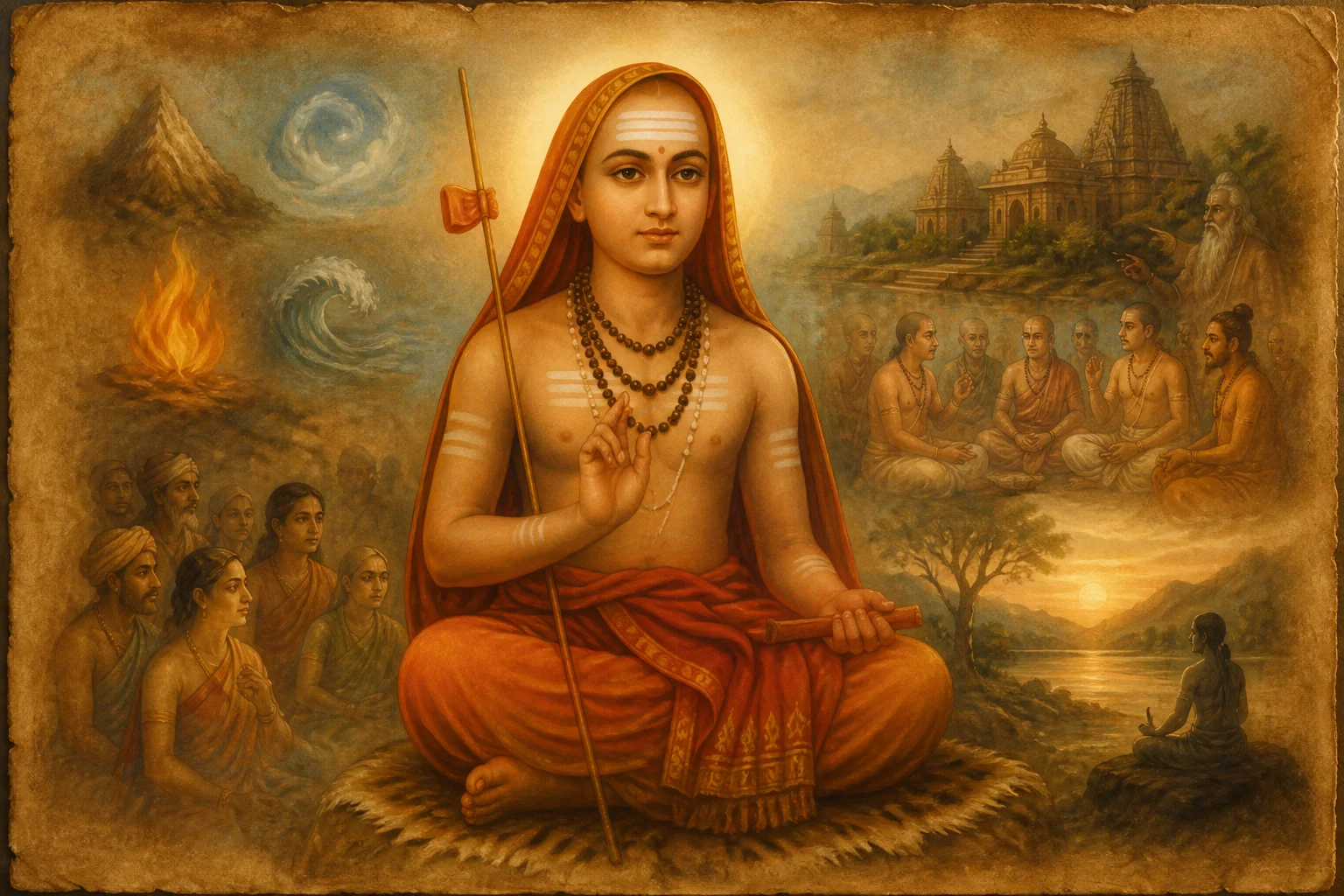
Dashashloki (also called Nirvana Dashakam) is among Shankaracharya's most direct Vedantic utterances. Tradition holds that when Govinda Bhagavatpada asked the young Shankara who he was, these ten verses burst forth, each closing with the affirmation that only Shiva, the auspicious Self, remains.
At a glance
- Deity
- Lord Shiva
- Verses
- 10 verses
- Chant time
- About 6 minutes (Vedantic core · ~6 min)
- Attribution
- Traditionally attributed to Adi Shankaracharya
- Sanskrit source
- sanskritdocuments.org · All sources
Verse overview
- 1
Elements and senses come and go, yet something abides in deep sleep. That unchanging witness, proved when all else is absent, is the solitary Shiva that I am.
- 2
Social roles and yogic practices belong to the body-mind, not to the Self. When the false 'I' and 'mine' are dropped, only the pure Shiva-nature remains.
- 3
In deep sleep no parent, god, scripture, or holy place is experienced, yet I remain. The Self is neither the void of sleep nor the world of waking: it is the…
- 4
No philosophical school defines the Self known in immediate experience. The absolutely pure Atman is not a doctrine but the reality in which all doctrines…
- 5
Direction and locality do not touch the Self that pervades like space. I am the partless, homogeneous reality in which all positions are imagined.
- 6
Colour and shape belong to objects, not to the Self that illumines them. I am the formless light in which all colours and forms are seen.
- 7
Teacher, taught, and teaching vanish in the knowledge of one's own nature. Realization leaves no second: no 'you,' no 'I,' no world apart from the one Self.
- 8
Waking, dream, and sleep are modifications rooted in ignorance. The Self is Turiya, the fourth that witnesses the three states without itself becoming any of…
- 9
The Self is self-evident, all-pervasive, and depends on nothing. The world apart from Brahman has no substantial reality; only Shiva, the one Self, truly is.
- 10
The ultimate truth cannot be captured by dualistic categories of one or two, void or non-void. The Upanishadic reality is advaita alone, beyond the reach of…
All verses
Open full textRelated works
Common questions
- When do people recite Dasha Shloki Stutih?
- Shaiva hymns are often chanted on Pradosham, during Shravan, and on Maha Shivaratri, as well as in short daily practice. This edition is labeled for practice as "Vedantic core · ~6 min" and takes about 6 minutes to chant.
- What is the opening focus of Dasha Shloki Stutih?
- Elements and senses come and go, yet something abides in deep sleep. That unchanging witness, proved when all else is absent, is the solitary Shiva that I am. Read verse 1 in Study mode for the full editorial note beside the Sanskrit.
- Which hymns pair well with Dasha Shloki Stutih?
- On this site, related reading includes Nirvana Shatakam, and Vedasara Shiva Stotram. Open those hubs for their own Sanskrit, English meaning, and study notes.