Complete · ~8 min chant
Vishnu Bhujanga Prayata Stotram
विष्णुभुजङ्गप्रयातस्तोत्रम्
Viṣṇubhujaṅgaprayātastotram
Fourteen verses from the formless Brahman to a moving prayer on old age, death, and liberation through Vishnu.
14 verses · About 8 min · Shri Vishnu
How do you want to read?
Chant one verse at a time, or open the full text to scroll the whole hymn.
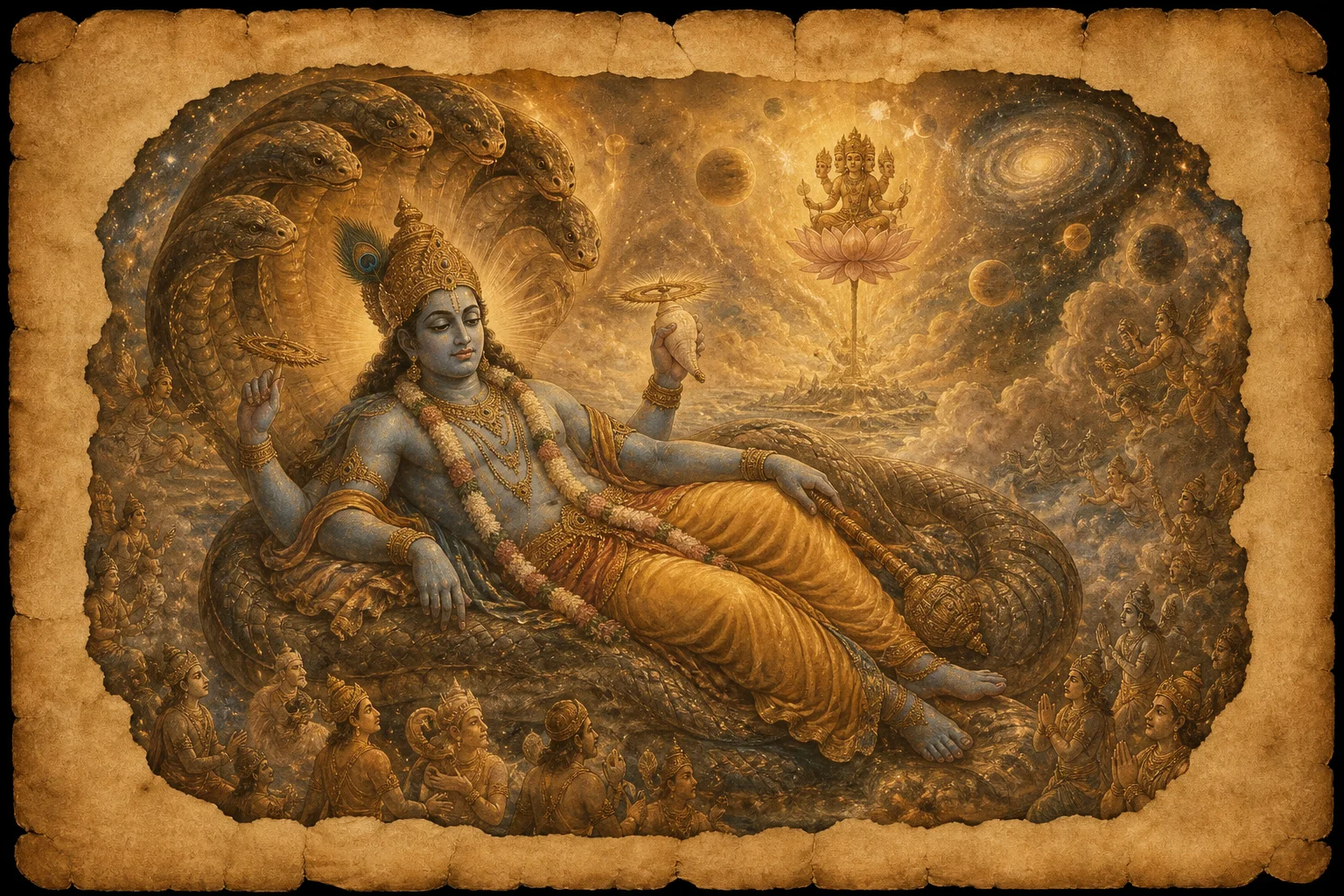
Vishnu Bhujanga Prayata Stotram is attributed to Sri Adi Shankaracharya. Its fourteen verses in the bhujanga metre open with Vedantic salutations to Vishnu as Para Brahman beyond qualities, then describe his radiant four-armed form with Lakshmi and Bhudevi, before turning into a poignant personal prayer on the loneliness of old age, the approach of death, and the hope that the Lord's name will be remembered with devotion at the final hour.
More about this stotra
The closing phala verse promises that whoever chants this hymn with fixed mind on Murari will cross the ocean of samsara. This edition presents the complete fourteen-verse recension with Devanagari, IAST, and editorial focus notes.
At a glance
- Deity
- Shri Vishnu
- Verses
- 14 verses
- Chant time
- About 8 minutes
- Attribution
- Traditionally attributed to Adi Shankaracharya
- Sanskrit source
- sanskritdocuments.org · All sources
Verse overview
- 1
Vishnu praised here is pure consciousness beyond form, reached through Om and known as turiya, the fourth. Salutation to the supreme Brahman of the Vedas is…
- 2
The Lord who is Shiva-peaceful and beginningless is the light and life of the world, beyond the limits of space and time. What the triple Veda declares is the…
- 3
Seated on the yogic throne of elements and Shakti, in the fire of the gunas, the Lord rests on the Om-lotus of the eight syllables. Meditation on this seat is…
- 4
Radiant beyond sun and moon yet neither hot nor cold, the Lord is self-luminous bliss-awareness. Such light is not seen by the outer eye but known as the…
- 5
The beautiful face with lotus eyes and jeweled crest is the form in which the formless Lord becomes visible to devotion. To see beauty in the divine image is…
- 6
The smile, the garland, and Kaustubha on the broad chest are signs of the Lord's overflowing grace made tangible. Form here is not distraction from truth but…
- 7
The four arms and lotus feet that outshine the lotus symbolize the Lord's power to uphold and to release. Feet that destroy the lotus of samsara are the refuge…
- 8
Meditating on the form shown to devotees while restraining the senses, one crosses samsara's ocean. The form is a bridge, not the final truth; salutation to…
- 9
Vishnu pleased by Lakshmi and Bhudevi is the Lord in whom prosperity and earth, spirit and matter, are united. The householder of three worlds teaches that the…
- 10
Alone one must leave all attachments, a bitter truth that turns the mind from the ephemeral to the eternal. Recognition of inevitable separation is the…
- 11
Old age devours the body while life remains, exposing the futility of clinging to what must decay. The plea to become the Lord's servant is the turning of the…
- 12
The failing body at death's door awakens fear of the unknown, yet fear itself arises in consciousness which does not die. The cry 'what shall I do?' opens to…
- 13
The prayer that divine names be on the tongue at death is prayer that consciousness rest in the Lord when form falls away. Each name points to the one…
- 14
The hymn's fruit is the swift dropping of moha and attainment of the imperishable Lord through yoga and grace. Reading with fixed mind is not mere repetition…
All verses
Open full textRelated works
Common questions
- When do people recite Vishnu Bhujanga Prayata Stotram?
- Many households recite Vishnu stotras in the morning or on ekadashi and other Vaishnava observances. This edition presents 14 verses and takes about 8 minutes to chant.
- What is the opening focus of Vishnu Bhujanga Prayata Stotram?
- Vishnu praised here is pure consciousness beyond form, reached through Om and known as turiya, the fourth. Salutation to the supreme Brahman of the Vedas is recognition that the Lord and the Self are not two. Read verse 1 in Study mode for the full editorial note beside the Sanskrit.
- Which hymns pair well with Vishnu Bhujanga Prayata Stotram?
- On this site, related reading includes Govindashtakam, and Hari Stutih. Open those hubs for their own Sanskrit, English meaning, and study notes.