Complete · ~6 min chant
Hari Stutih
हरिस्तुतिः
Haristutiḥ
Twelve opening verses of Shankara's Harimide hymn, each closing with praise of Hari who dispels the darkness of samsara.
12 verses · About 6 min · Shri Vishnu
How do you want to read?
New here? Read the full text first, or go verse by verse to chant.
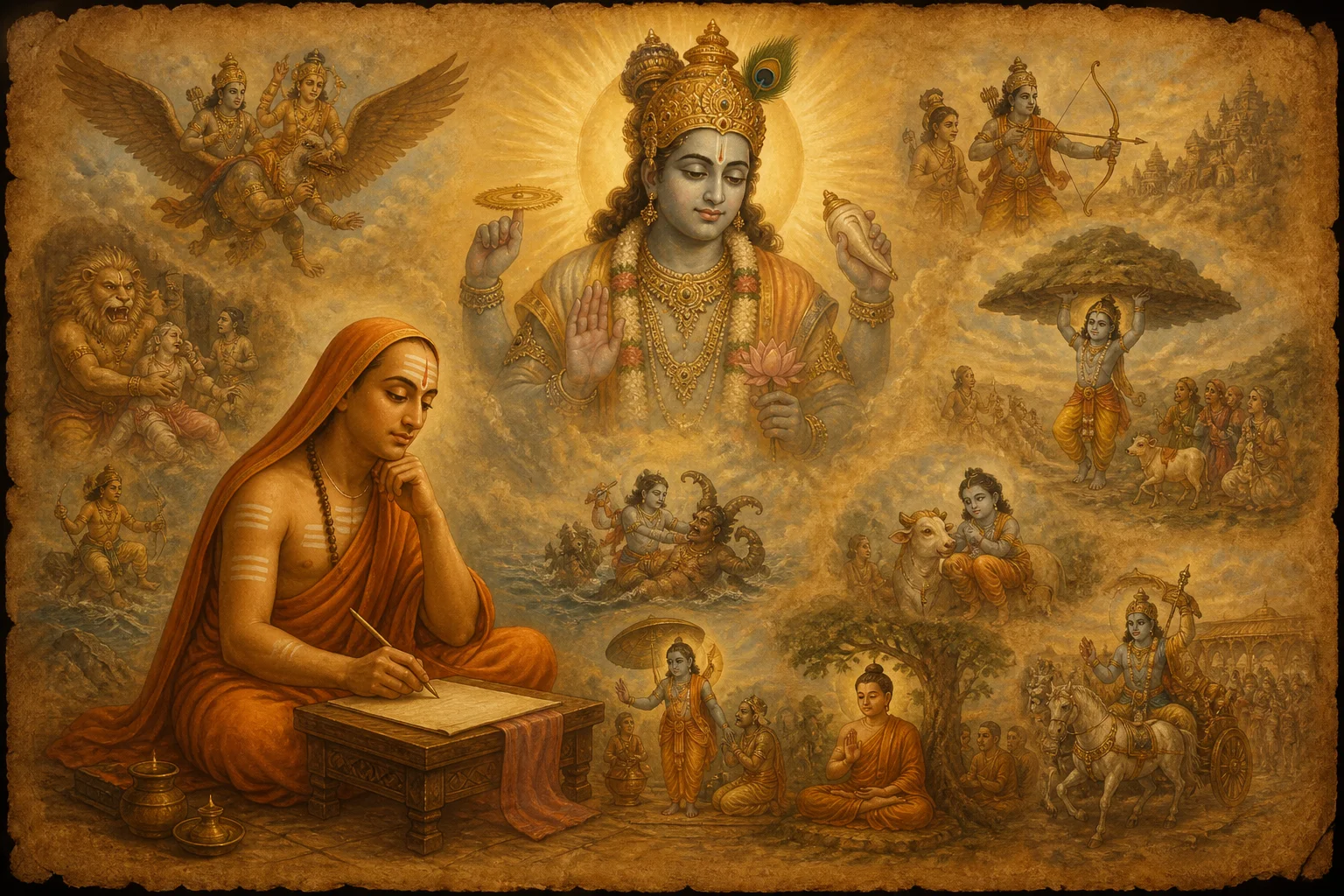
Hari Stutih, also called Harimide Stotram, is among the most philosophically rich hymns attributed to Sri Adi Shankaracharya. In forty-four verses the Acharya praises Lord Vishnu as the supreme Brahman while expounding the essence of the Upanishads. Each verse closes with the refrain *taṃ saṃsāradhvāntavināśaṃ harimīḍe*: I praise that Hari who destroys the darkness of worldly existence.
More about this stotra
This edition presents the first twelve verses, which establish the theme of samsara as a revolving wheel destroyed by knowledge of the Lord. The hymn bridges devotion and Vedanta: Vishnu is not only the beloved deity but the one consciousness in whom the world arises, abides, and is known.
At a glance
- Deity
- Shri Vishnu
- Verses
- 12 verses
- Chant time
- About 6 minutes
- Attribution
- Traditionally attributed to Adi Shankaracharya
- Sanskrit source
- sanskritdocuments.org · All sources
Verse overview
- 1
The wheel of becoming turns only in the Lord who is also its ground; to see Him is to see that the cycle never truly bound the Self. Praise of Hari turns the…
- 2
The world arises from a fraction of the Lord yet He remains whole, for manifestation does not divide consciousness. What is pervaded and known as pleasure and…
- 3
Hari is all-knowledge, all beings, and bliss itself, yet also the unmanifest in which the many and the one are resolved. The distinction of real and unreal…
- 4
Nothing apart from Hari is ultimately real, for He is consciousness without object. Beyond the triad of knower, knowing, and known, the Self shines always as…
- 5
The subtle teaching received from the guru, joined with dispassion and steady practice, turns the mind one-pointed toward the Lord. Such devotion is not other…
- 6
With breath restrained and mind fixed on Om in the heart, thought dissolves and the truth 'I am That' shines forth. Hari praised here is the Self revealed when…
- 7
Hari called Brahman is the fullness in the heart, subtle and unborn, reached not by argument but by abiding as the Self. The seers of Brahman know the Lord by…
- 8
Beyond all measure and object of knowledge, Hari is the self-luminous bliss realized in the heart. The non-dual joy that feeling alone can touch is none other…
- 9
Every perceived object is Brahman, and the seer too is That; this is the meditation of sages like Sanaka. Seeing Hari in all things and as the Self dissolves…
- 10
By neti neti the seeker strips away every object until only self-luminous bliss remains, and knows 'I am That.' The Lord known to the Self-realized is the…
- 11
When all perceived distinctions are abandoned, only the sky-like Self remains, and the devotee enters the imperishable Lord even while leaving the body. Entry…
- 12
Hari is the indwelling Self of all, knowing everything yet unknown to the many who take themselves to be only the body. To praise Him as antaryamin is to turn…
All verses
Open full textRelated works
Common questions
- When do people recite Hari Stutih?
- Many households recite Vishnu stotras in the morning or on ekadashi and other Vaishnava observances. This edition presents 12 verses and takes about 6 minutes to chant.
- What is the opening focus of Hari Stutih?
- The wheel of becoming turns only in the Lord who is also its ground; to see Him is to see that the cycle never truly bound the Self. Praise of Hari turns the mind from the revolving world toward the still awareness in which birth and death appear and vanish. Read verse 1 in Study mode for the full editorial note beside the Sanskrit.
- Which hymns pair well with Hari Stutih?
- On this site, related reading includes Shatpadi Stotram, and Bhaja Govindam. Open those hubs for their own Sanskrit, English meaning, and study notes.