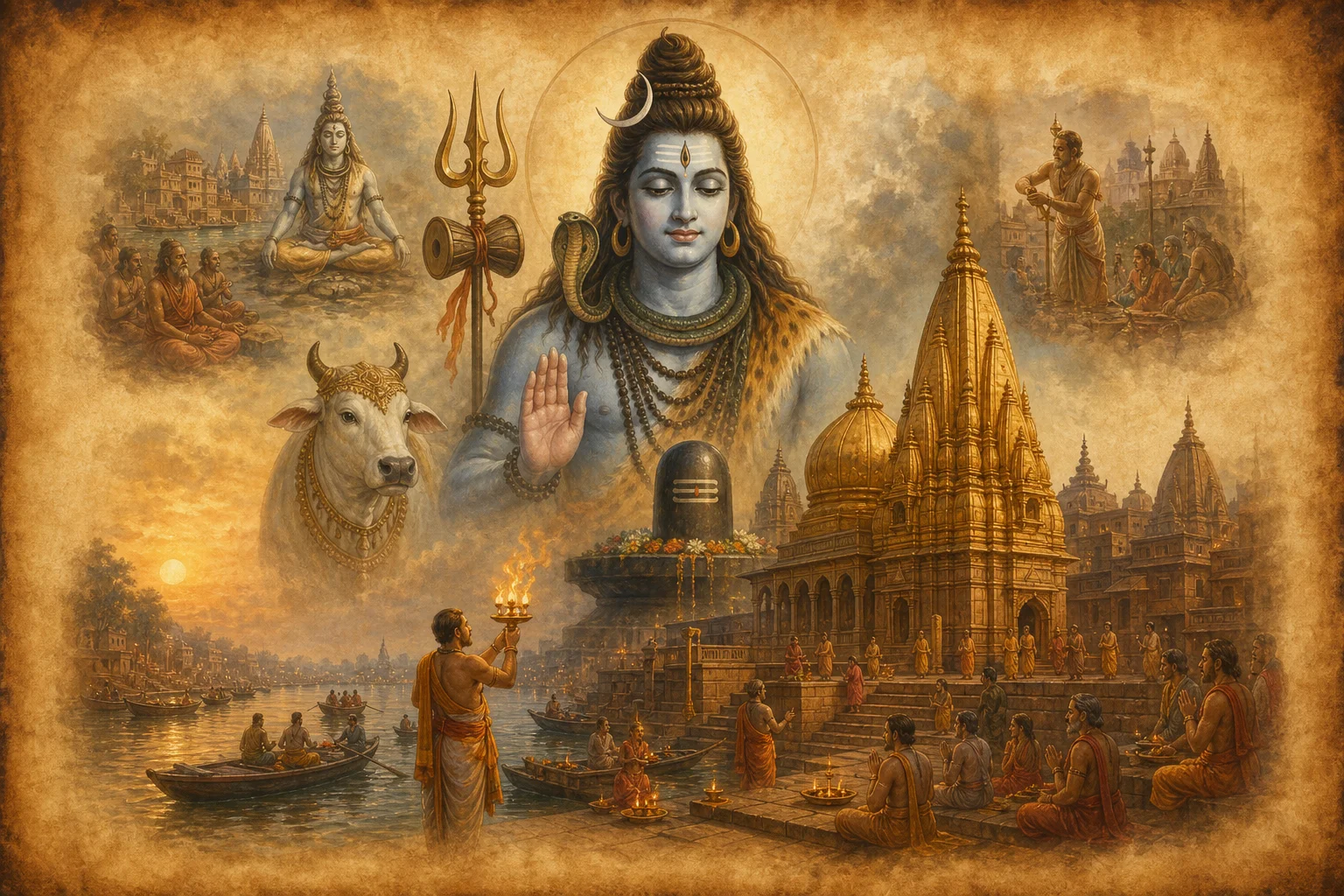
Complete · Kashi praise · ~5 min · ~5 min chant
Vishwanathashtakam
विश्वनाथाष्टकम्
Viśvanāthāṣṭakam
Eight verses to Kashi Vishvanatha, each closing with the refrain to worship the Lord of Varanasi.
8 verses · About 5 min · Lord Shiva
How do you want to read?
New here? Read the full text first, or go verse by verse to chant.
Vishwanathashtakam is an eight-verse hymn to Shiva as Lord of Kashi, traditionally attributed to Adi Shankaracharya. Each verse closes with the refrain to worship Vishvanatha, Lord of Varanasi. This edition offers Devanagari, IAST, English meaning, and editorial Advaita study notes.
Vishwanathashtakam is a beloved hymn to Shiva as Lord of Varanasi. Each of its eight verses paints another aspect of Vishvanatha - Ganga in his locks, Gauri at his side, conqueror of Kama and death - and closes with the refrain: worship the Lord of Varanasi, Vishvanath.
More about this stotra
Tradition links the hymn to devotion at the Vishwanatha shrine and to the wider circle of Kashi stotras. Recite it when you want a short, refrain-driven praise of the Lord of Varanasi rather than a long narrative hymn. This edition presents the eight-verse ashtakam with Devanagari, IAST, and editorial focus notes for study beside the chant.
At a glance
- Deity
- Lord Shiva
- Verses
- 8 verses
- Chant time
- About 5 minutes (Kashi praise · ~5 min)
- Attribution
- Traditionally attributed to Adi Shankaracharya
- Sanskrit source
- sanskritdocuments.org · All sources
- Guide
- Reading guide
Traditional context
Vishwanathashtakam praises Shiva as Vishvanatha, Lord of Varanasi. It is among the most familiar short Shaiva hymns tied to Kashi pilgrimage and household worship of the city's linga.
Devotees often recite it on Maha Shivaratri, during visits to the Vishwanatha temple, or as a compact daily homage to the Lord who wears Ganga and sits with Gauri.
Structure of this recension
Eight verses each paint another aspect of the Lord - Ganga in his locks, Gauri at his left, serpent ornaments, tiger skin, conqueror of Kama and death - and close with the same refrain: worship the Lord of Varanasi, Vishvanath.
The refrain makes the hymn easy to memorise while the imagery stays dense and specific to Kashi.
How to read this edition
Sanskrit appears in Devanagari with optional IAST and regional-script transliteration. Each verse includes an editorial English study note from an Advaita-informed perspective.
These notes are reflections for contemplation, not Shankaracharya's own commentary or a traditional bhashya.
Suggested practice
Chant all eight verses in a single sitting, or take one verse a day with its study note. Pair with Kalabhairavashtakam and Manikarnikashtakam for a Kashi reading sequence, or with Kashi Panchakam when you want pilgrimage imagery and Self-inquiry together.
Verse overview
- 1
Ganga on his locks and Gauri on his left image the Lord as the meeting of purifying stream and creative power; worship of Kashi's king turns pilgrimage outward…
- 2
Beyond words yet served by the gods of speech and preservation, he is known only when speech falls silent; the Lord with Uma on his left teaches that the…
- 3
Lord of bhutas with serpent and tiger, trident and noose in hand, shows the powers that bind and release as one Lord's gifts; worship acknowledges that…
- 4
Moon-crest and brow-fire that burned desire's arrows unite coolness and fierce light in one face; the Lord who dries Kama teaches that passion is overcome not…
- 5
Fire to sin-maddened elephants and to the forest of death, grief, and age, he consumes what binds the embodied soul; the five faces see every quarter of…
- 6
Saguna and nirguna, with and without parts, he is the immeasurable bliss-root and Self-form; this verse names the Lord explicitly as Atman, inviting worship to…
- 7
Free from passion yet full of love for devotees, abode of vairagya and shanti, beautiful with poison, he holds opposites without conflict; the Lord's sweetness…
- 8
The closing verse turns from description to discipline: drop hope, blame, and sinful clinging, place the heart-lotus on the Supreme, and worship; Vishvanatha…
All verses
Open full textRelated works
Common questions
- When do people chant Vishwanathashtakam?
- Many recite it during Kashi pilgrimage, on Maha Shivaratri, and as a short daily Shiva hymn. It pairs naturally with Kalabhairavashtakam and Manikarnikashtakam for a Varanasi-themed sequence.
- Is Viswanathashtakam the same hymn?
- Yes. Viswanathashtakam and Vishvanathashtakam are common spellings of the same eight-verse praise of Kashi Vishwanatha. The refrain bhaja visvanatham returns in every verse.
- How does this hymn relate to Kashi Panchakam?
- Vishwanathashtakam praises the city's Lord in image and refrain. Kashi Panchakam turns the same sacred geography inward, identifying Kashi with one's own awareness. Reading both shows outer pilgrimage and inner tirtha side by side.