Complete · ~15 min chant
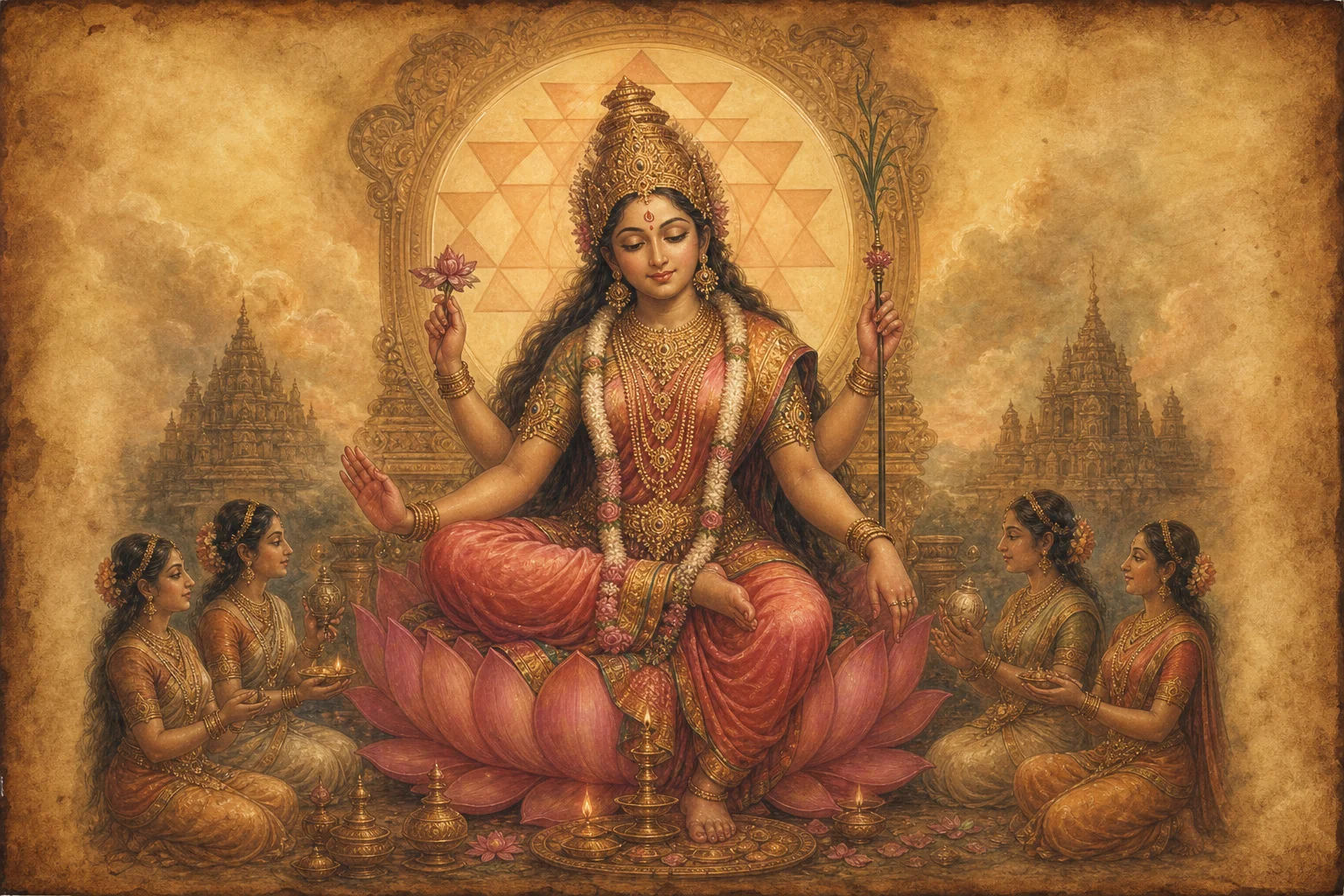
Devi Bhujanga Stotram
देवीभुजङ्गस्तोत्रम्
Devībhujaṅgastotram
Twenty-eight verses in bhujanga metre praising Tripurasundari as Shankaradvaita, the non-dual Shakti.
28 verses · About 15 min · Shri Devi
How do you want to read?
Chant one verse at a time, or open the full text to scroll the whole hymn.
Devi Bhujanga Stotram is attributed to Sri Adi Shankaracharya and composed in the bhujanga-prayata metre. It opens with the Goddess enthroned on supreme bliss, surrounded by the five lokapalas, and celebrates her as Shankaradvaitam, the non-dual reality one with Shiva.
More about this stotra
The hymn weaves Sri Vidya contemplation with Advaitic insight: the Devi hidden in the five koshas, sporting as Brahma and other deities, yet resting beyond knower, knowing, and known. The closing verse offers childlike praise, asking the Mother to accept stumbling words with indulgence. This edition presents the complete twenty-eight-verse recension with Devanagari, IAST, and editorial focus notes.
At a glance
- Deity
- Shri Devi
- Verses
- 28 verses
- Chant time
- About 15 minutes
- Attribution
- Traditionally attributed to Adi Shankaracharya
- Sanskrit source
- sanskritdocuments.org · All sources
Verse overview
- 1
Tripura enthroned on bliss, guarded by lokapalas, is Shankaradvaita herself. To seek her protection is to rest in the Shakti never separate from…
- 2
Hidden in the five koshas on the yogic throne dwells Shiva whom the hymn calls the Devi's inner realm. The sheaths that seem to veil the Self are themselves…
- 3
When the Devi rests in her own Self after cosmic play, she is beyond the triple division of knower, knowing, and known. That supreme bliss is what Advaita…
- 4
She who splits consciousness into jiva and Shiva for play can restore either to its true nature. The apparent duality of soul and Lord is her līlā; awakening…
- 5
Yogis who merge prana in the heart and reach the brow enter her saccidananda-pada and attain Shiva-hood. The path through the chakras is ascent to the one…
- 6
Body, family, and wealth hold the mind through fear until her katāksha grants release. Without the Mother's glance, detachment remains impossible and tattva…
- 7
For the disciple guided by a sadguru, the flash of bliss-light in samadhi is the living truth of Tat tvam asi. The Devi reveals herself as the sole reality…
- 8
Sages dispute whether the world is real, unreal, or mind-born, yet every measure is her alone. Advaita does not need one metaphysical label when the Goddess is…
- 9
Through the five kalas from nivritti to shantyatita she manifests the twenty-five tattvas yet remains one with Shiva. Sri Vidya worship centres on her as the…
- 10
Drowning in samsara's mire, bound by family and delusion, only the Mother can raise the devotee. Surrender to her is surrender to the power that alone cuts the…
- 11
Ascending from muladhara to the Brahma chakra, the yogi enters the Devi's wheel and worships through nada. Inner ascent is not escape from the world but entry…
- 12
She is not separate from Ganesha, planets, nakshatras, or the yogini pithas; as Mahakala herself she governs creation and preservation. The cosmos is her body,…
- 13
Her book and rosary signify knowledge and mantra; her moon-bright form is pure consciousness. One glimpse in meditation wins Sarasvati's love because wisdom…
- 14
Her solar face outshines universes yet holds the weapons of disciplined power. To meditate on such splendour is to train the mind to see the world as radiance,…
- 15
Meditation on her golden form steadies the mind that otherwise chases flickering fortune. Steadfastness in the heart-lotus replaces the restlessness that…
- 16
The Para-bija mapped on face, breast, and guhya is the Devi's own body of sound. To meditate the mantra-body is to discover that the worshipper and the…
- 17
Sages who rest in her three bindus and the ocean of para-ananda never return through the gate of rebirth. Freedom here is immersion in bliss-awareness, not a…
- 18
Gods worshipped as drops of her gunambhodhi still depend on her līlā. Devotees who know this do not chase lesser powers but aim to cross samsara through her…
- 19
The poet pleads for the foot-boat that ferries across becoming's ocean. When delusion's poison-sea is seen clearly, indifference from the Mother would be…
- 20
Equanimity, freedom from friend-and-foe duality, and uprooting of the mind are fruits of her grace. The questions voice the Advaitin longing for the settled…
- 21
The gods' crowns lit at her feet show that even Brahma bows to the ground of all worship. Salutation to Gauri's feet is the ego's surrender to the light in…
- 22
Her weapons and beauty are the form in which the formless delights Shiva. To treasure her love-glance is to centre the mind in the bliss that dissolves…
- 23
The yogic replacement of senses with her form is pratyahara turned to devotion. When every sense rests in the Devi, the mind's vritti finally abides in the one…
- 24
The hymn honours Shiva-lovers who crossed samsara and embody Vedic essence. Their compassion and steadfast dharma show the fruit of knowing the Devi as the far…
- 25
The mind is placed where the Devi sits beside Shiva in the golden Sri chakra. That seat in consciousness-bliss is the true altar, not any outer shrine.
- 26
Her love-sport at the eye's corner is the universe's indrajala seen from within. Sages' hearts are her hall because pure awareness is where she dances as sweet…
- 27
When the Devi alone creates, acts, and enjoys, the ego's merit, sin, bondage, and moksha dissolve. This is the Advaitic confession that all karma belongs to…
- 28
The closing humility admits that 'mine' and 'yours' were never finally understood. The Mother's indulgence of childish praise mirrors Brahman receiving the…
All verses
Open full textRelated works
Common questions
- When do people recite Devi Bhujanga Stotram?
- Devi hymns are widely recited on Fridays, during Navaratri, and as morning Mother-worship. This edition presents 28 verses and takes about 15 minutes to chant.
- What is the opening focus of Devi Bhujanga Stotram?
- Tripura enthroned on bliss, guarded by lokapalas, is Shankaradvaita herself. To seek her protection is to rest in the Shakti never separate from Shiva-consciousness. Read verse 1 in Study mode for the full editorial note beside the Sanskrit.
- Which hymns pair well with Devi Bhujanga Stotram?
- On this site, related reading includes Soundarya Lahari, and Tripura Sundaryashtakam. Open those hubs for their own Sanskrit, English meaning, and study notes.