Complete · Madurai hymn · ~4 min · ~4 min chant
Minakshi Pancharatnam Stotram
मीनाक्षी पञ्चरत्नम् स्तोत्रम्
Mīnākṣī Pañcaratnam Stotram
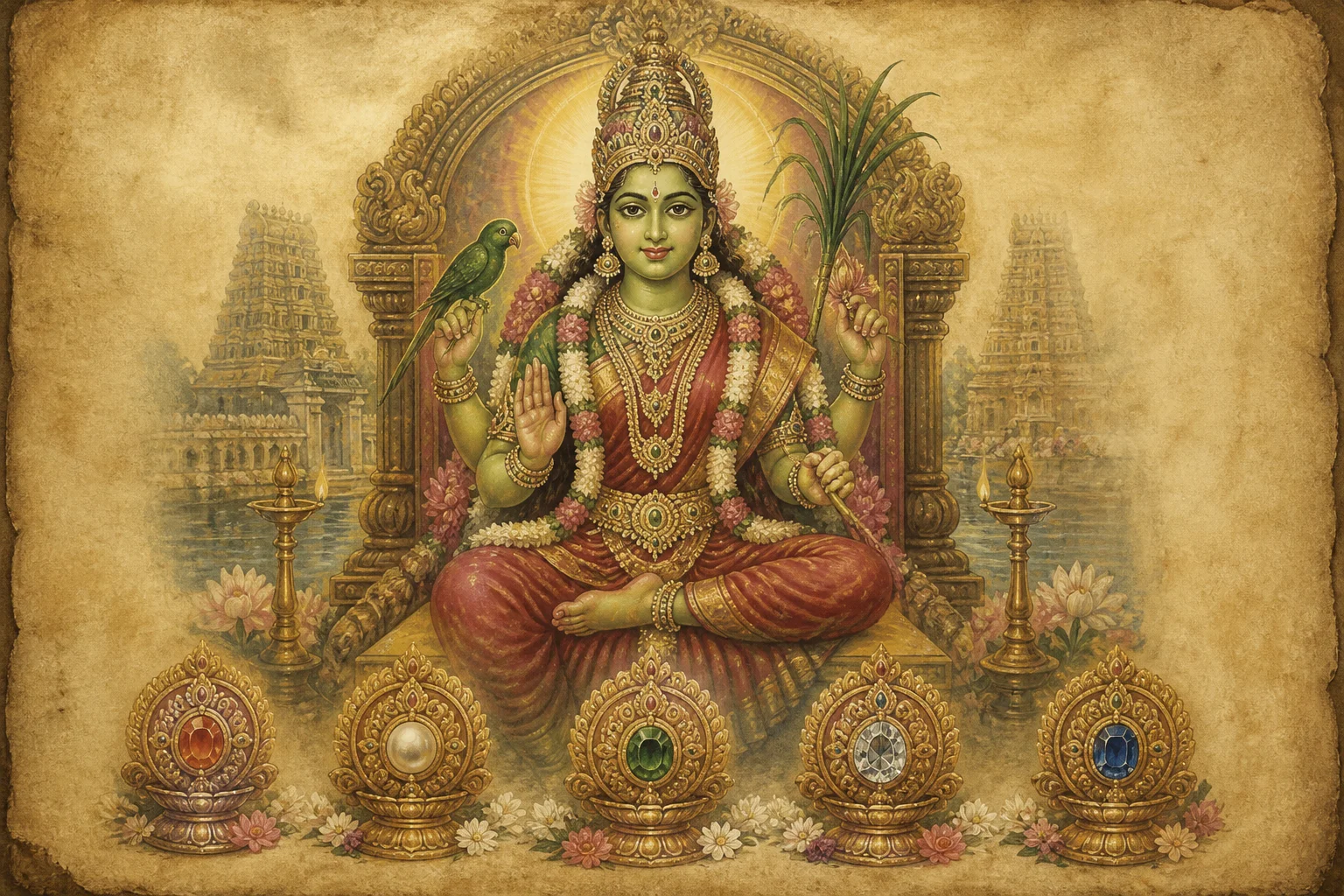
Five jewels of praise to Meenakshi of Madurai, the fish-eyed Sri Vidya queen.
5 verses · About 4 min · Shri Devi
How do you want to read?
New here? Read the full text first, or go verse by verse to chant.
Minakshi Pancharatnam is a five-verse hymn to Goddess Meenakshi of Madurai, traditionally attributed to Adi Shankaracharya. Each verse closes with a refrain of perpetual bowing to the ocean of compassion. This edition includes Sanskrit, English meaning, and study notes.
Minakshi Pancharatnam Stotram is a five-verse hymn to Goddess Meenakshi of Madurai, traditionally attributed to Sri Adi Shankaracharya during his travels in the Pandya country. Each verse ends with the refrain *mīnākṣīṃ praṇato ’smi santatam ahaṃ kāruṇyavārāṃnidhim*: "I bow forever to Meenakshi, the ocean of compassion."
More about this stotra
The poem honours her as both regal queen of the Sabha and supreme Sri Vidya deity dwelling in the chakra's centre. Her fish-shaped eyes, golden splendour, and musical grace are not mere courtly praise: they express the Divine Mother's power to grant knowledge, remove fear, and gather the heart into devotion.
At a glance
- Deity
- Shri Devi
- Verses
- 5 verses
- Chant time
- About 4 minutes (Madurai hymn · ~4 min)
- Attribution
- Traditionally attributed to Adi Shankaracharya
- Sanskrit source
- sanskritdocuments.org · All sources
Traditional context
Minakshi Pancharatnam Stotram praises Goddess Meenakshi of Madurai. Tradition links it to Shankaracharya's travels in the Pandya country.
The hymn honours her as regal queen of the sabha and as Sri Vidya Mother whose fish-shaped eyes signal compassion and knowledge.
Structure of this recension
Five verses end with the refrain of perpetual bowing to Meenakshi, the ocean of compassion.
Imagery of golden splendour, music, and sovereignty gathers courtly praise into devotion rather than remaining mere description.
How to read this edition
Editorial notes invite contemplation of the Mother's glance as grace, not as a tourist caption for Madurai alone. This is a reader edition with study aids, not a traditional bhashya.
Suggested practice
Memorise the five verses with the shared refrain. Pair with Lalita Pancharatnam and Tripura Sundaryashtakam for a short Devi jewel sequence.
Verse overview
- 1
The radiance likened to countless suns is the light of consciousness itself, not a distant deity. Bowing to the fish-eyed Goddess is turning inward to the…
- 2
She who grants every wish is the inner fullness that no external object can satisfy. When the mind ceases to chase desires, that fullness reveals itself as the…
- 3
The bindu at the heart of the Sri Chakra is the point where subject and object merge. She who dwells there is the power of consciousness by which the universe…
- 4
Fear departs when knowledge of the Self arises, for what is there to fear when the witness is discovered? The music she loves is the harmony of life lived as…
- 5
She who dwells in the hearts of sages as Nada-Brahman is the soundless sound at the root of Om. All attainments and truths are waves on the ocean of the one…
All verses
Open full textRelated works
Common questions
- Is Meenakshi Pancharatnam the same as Minakshi Pancharatnam?
- Yes. Meenakshi is the common Tamil and English temple spelling; Minakshi follows a Sanskrit-leaning transliteration. Both names refer to this five-verse Madurai hymn.
- How is this different from Lalita Pancharatnam?
- Both are five-jewel Devi hymns, but they are distinct texts. Lalita Pancharatnam is a dawn upasana to Lalita; Minakshi Pancharatnam praises Meenakshi of Madurai with a recurring refrain of bowing to the ocean of compassion.
- When do people recite this hymn?
- Devotees often chant it in connection with Madurai Meenakshi worship, temple visits, and Sri Vidya-oriented Mother devotion. It also works as a short daily pancharatnam beside other Devi jewels on this site.