Complete · ~14 min chant
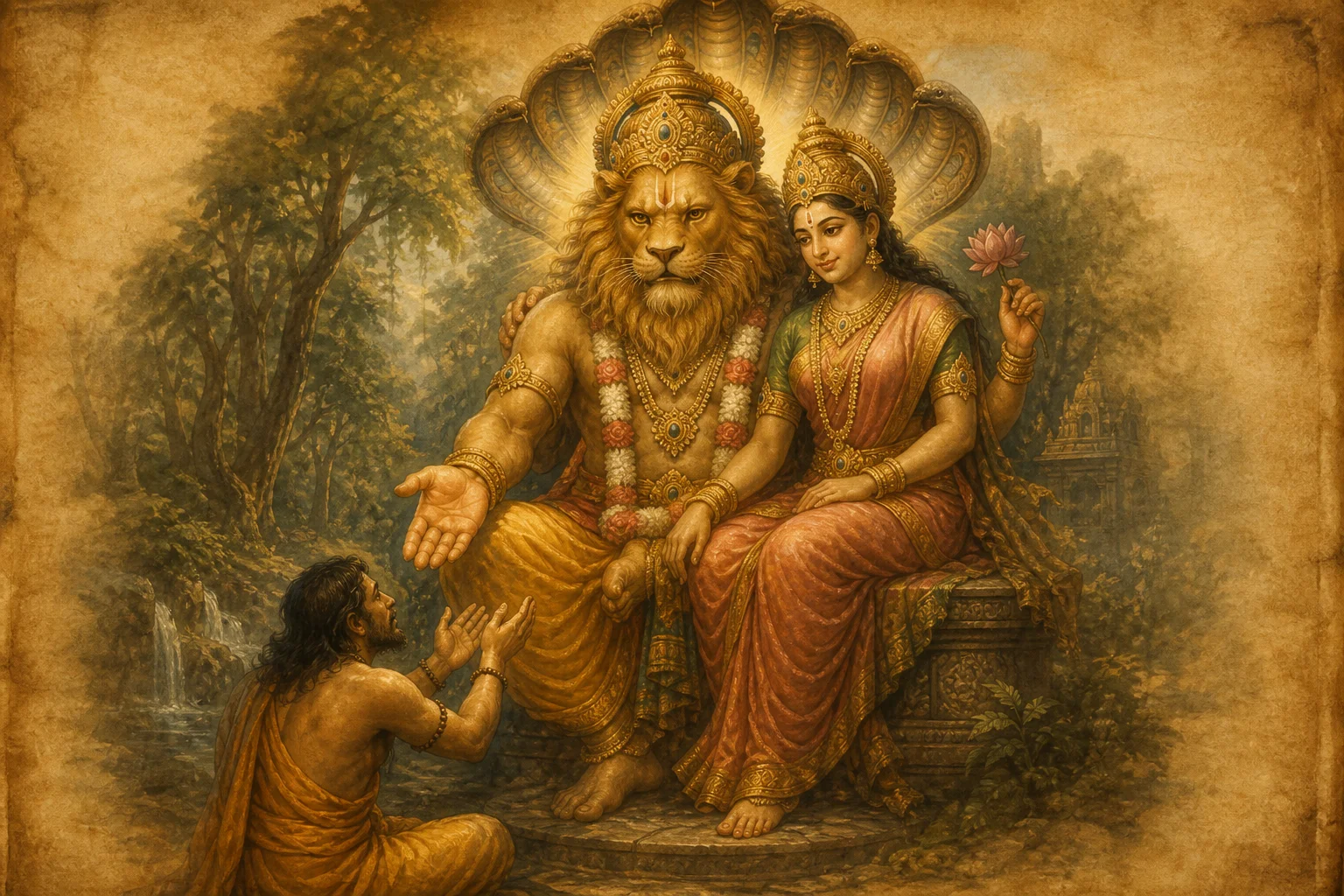
Lakshmi Nrisimha Karunarasa Stotram
लक्ष्मीनृसिंहकरुणारस स्तोत्रम्
Lakṣmīnṛsiṃhakaruṇārasa Stotram
Twenty-five verses crying 'mama dehi karavalambam' to Lakshmi-Nrisimha, the supporting hand in samsara's forest.
25 verses · About 14 min · Shri Vishnu
How do you want to read?
Chant one verse at a time, or open the full text to scroll the whole hymn.
Lakshmi Nrisimha Karunarasa Stotram, also called Karavalamba Stotram, is a twenty-five-verse hymn to Lakshmi-Narasimha, traditionally attributed to Adi Shankaracharya. Each verse ends asking for the Lord's supporting hand. This reader offers Sanskrit, English meaning, and editorial notes.
Lakshmi Nrisimha Karunarasa Stotram (also called Karavalamba Stotram) is attributed to Sri Adi Shankaracharya. Each of its twenty-five verses ends with the refrain mama dehi karavalambam: grant me your supporting hand. The hymn pictures the devotee caught in samsara's terrible forest, bitten by the serpent of time, seized by passion's crocodile, and bound by family ties, crying to the Lord who tore Hiranyakashipu.
More about this stotra
The stotra is widely chanted for protection and is especially beloved in Nrisimha worship. This edition presents the complete twenty-five-verse recension with Devanagari, IAST, and editorial focus notes.
At a glance
- Deity
- Shri Vishnu
- Verses
- 25 verses
- Chant time
- About 14 minutes
- Attribution
- Traditionally attributed to Adi Shankaracharya
- Sanskrit source
- sanskritdocuments.org · All sources
Traditional context
Lakshmi Nrisimha Karunarasa Stotram, also called Karavalamba Stotram, praises the Lord who tore Hiranyakashipu while Lakshmi's compassion softens the fierce form.
It is widely chanted for protection and is especially beloved in Nrisimha worship across many regions.
Structure of this recension
Twenty-five verses end with the refrain mama dehi karavalambam: grant me your supporting hand.
Imagery pictures the devotee caught in samsara's forest, bitten by the serpent of time, seized by passion's crocodile, and bound by family ties, crying to the Lord for that handhold.
How to read this edition
Focus notes treat the terrifying and the compassionate as one refuge. They are editorial study aids, not a traditional bhashya or a guarantee of worldly outcomes.
Suggested practice
Recite when the refrain itself is the practice: return again and again to asking for the supporting hand. Take five verses a day to complete the hymn in five days, or chant the full text on Nrisimha-centred observances.
Verse overview
- 1
Lakshmi-Nrisimha on the ocean of milk with chakra in hand is the eternal refuge and boat across saṃsāra. The supporting hand sought in prayer is the Self…
- 2
Feet that outshine the crowns of all gods point to a glory beyond every worldly rank. The swan on Lakshmi's breast images the Lord as the pure consciousness…
- 3
Saṃsāra as a forest and affliction as deer describe the mind hunted by fear and passion. Only the Lord's hand lifts the soul from the burning heat of envy into…
- 4
The deep pit of worldly existence and serpents of sorrow image bondage to the body-mind. Surrender at the Lord's feet is the recognition that only grace can…
- 5
Time as crocodile and passion as waves show saṃsāra's grip on the embodied soul. The cry for karāvalamba is the mind turning from struggle to the Lord who…
- 6
The tree of saṃsāra grows from sinful seed through senses and desire into sorrowful fruit. Climbing it in fear, the devotee sees that only the Lord's hand…
- 7
Serpent-venom of saṃsāra destroys the false form built on ignorance. The Lord who rides Garuda and dwells in nectar is the antidote to poison and fear.
- 8
The forest-fire of saṃsāra burns the body and mind until only refuge at the Lord's lotus feet remains. Surrender of the head is the ego's final offering into…
- 9
Caught on the hook of sense-objects, the embodied being trembles like a fish on the line. The Lord as world-abode is the reality in which the net of saṃsāra is…
- 10
Saṃsāra crushes the body like an elephant while death-fear confounds the mind. The Lord who destroys misery is the deathless Self beyond birth and departure.
- 11
Senses steal discrimination and cast the mind into delusion's cave. Blindness here is loss of viveka; the Lord's hand restores the inner sight that sees the…
- 12
The litany of names gathers every form of the Lord into one prayer. The wretched one who calls on all names discovers they point to the single Self beyond name…
- 13
Śaṅkara composed this hymn as a bee at the Lord's lotus feet for those drowning in māyā's flood. The stotra itself is the hand extended to lift the embodied…
- 14
Bewildered in the ocean of becoming, the devotee asks the compassionate Lord to look. He who removed Prahlāda's sorrow is the same Self that ends the devotee's…
- 15
Messengers of death and bonds of karma drag the helpless soul. Fear and subjection to another's will describe bondage to the not-Self; only the merciful Lord's…
- 16
The Lord stands with weapons and mudrās of protection while supporting Lakshmi. His form is the visible promise that the supreme supports both power and grace…
- 17
He dwells in the hearts of the greatest devotees across ages. The pārijāta who protects those who praise him is the inner Lord reached through continuous…
- 18
Saṃsāra's herd threatens like a lion's fangs; the Lord terrifies only evil. Removing fear of death is the gift of knowing the Self that neither is born nor…
- 19
Those who recite this hymn with Hari-bhakti reach the Lord's undivided lotus feet. The text promises what Advaita affirms: devotion leads to the non-dual…
- 20
The Lord is without beginning or end, praised by sun and scripture. Lakshmi as ocean-born bee images śakti delighting in the honey of the Self, the alone-real…
- 21
The Lord appears in many avatāras yet remains one playful reality worshipped by the gods. The haṃsa, supreme swan, is the Self that discriminates amid the…
- 22
When all relations are Nrisimha, the world is seen as the Lord alone. This is the Advaitic vision in which master, mother, father, and friend collapse into the…
- 23
The Lord as bee in Prahlāda's heart shows devotion's inward abode. Beauty, Gaṅgā's purity, and Lakshmi's presence image the gracious form that draws the mind…
- 24
Constant recitation frees stain and raises the devotee among sages. The hymn is both prayer and pointer: purity comes through turning the mind to the Lord who…
- 25
The closing salutation names the Lord as cure for the threefold misery and the diseases of craving. As Guru and Hari he is the inner teacher whose grace ends…
All verses
Open full textRelated works
Common questions
- Is Karavalamba Stotram the same as this hymn?
- Yes. Karavalamba Stotram is the common name from the refrain mama dehi karavalambam, grant me your supporting hand. Lakshmi Nrisimha Karunarasa Stotram is the fuller title used for the same twenty-five-verse working text.
- How should Nrisimha or Narasimha be spelled in search?
- Nrisimha follows a Sanskrit-leaning transliteration; Narasimha is the usual English spelling. Both refer to the man-lion form. This hub uses Nrisimha in the slug and title while recognising Narasimha in common speech.
- When do people chant this stotram?
- It is widely recited for protection and in Nrisimha worship, especially when fear, entanglement, or family bondage feels overwhelming. The refrain makes it suitable for sustained plea rather than a single short ashtakam.