Complete · ~10 min chant
Mantra Matrika Pushpamala Stavah
मन्त्रमातृकापुष्पमालास्तवः
Mantramātṛkāpuṣpamālāstavaḥ
Seventeen verses of mental worship offering a matrika garland of flowers to the Divine Mother.
17 verses · About 10 min · Shri Devi
How do you want to read?
Chant one verse at a time, or open the full text to scroll the whole hymn.
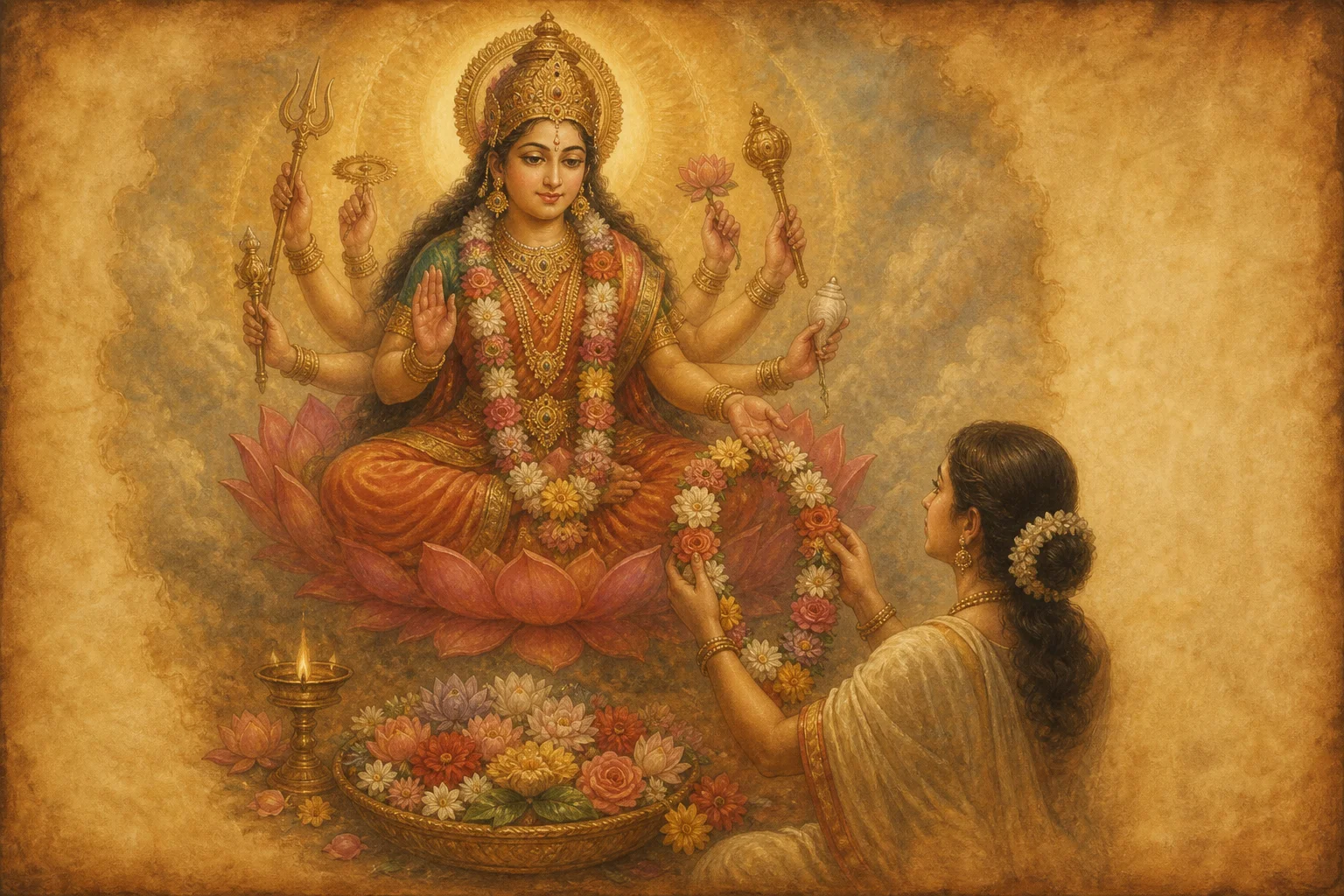
Mantra Matrika Pushpamala Stavah (also called Parvati Manasa Stotram) is attributed to Sri Adi Shankaracharya. It guides the devotee through a mental puja in the jewelled hall of the Sri Chakra, offering padya, arghya, bath, food, ornaments, and flowers to the Goddess enthroned on the lion-seat.
More about this stotra
Each verse is a petal in the matrika garland of worship. This edition presents the seventeen-verse recension found in the Stotrarnava collection, with Devanagari, IAST, and editorial focus notes.
At a glance
- Deity
- Shri Devi
- Verses
- 17 verses
- Chant time
- About 10 minutes
- Attribution
- Traditionally attributed to Adi Shankaracharya
- Sanskrit source
- sanskritdocuments.org · All sources
Verse overview
- 1
The throne made of the jewel of thought shows that mental worship builds its shrine from purified imagination. When the seat is thus fashioned, the Mother is…
- 2
She who stands in the Sri Chakra is the power that governs the universe from its geometric centre. Meditating her weapons and smile together, the devotee holds…
- 3
Offerings prepared with devotion are accepted by the ocean of compassion, not by ritual skill alone. The fruit of Shiva is granted when worship is offered to…
- 4
Bath offered in the mind purifies the subtle body of thought. The yogis' goal is pleased when every stream of imagination is poured out in service to the one…
- 5
Garments marked with Hrim clothe the deity in the very sound of her power. The golden thread is the thread of knowledge linking the worshipper to the Mother…
- 6
Ornaments offered to the Goddess adorn the devotee's own inner life with virtue and steadiness. Each jewel stands for a quality that makes the mind a fit…
- 7
Fragrance and cosmetic adornment symbolize the refinement of every faculty toward the divine. When the whole body is anointed in the mind, the devotee sees the…
- 8
Each flower in the garland is a matrika-letter, a petal in the alphabet of worship. Offering them by resolve alone, the devotee learns that the Mother accepts…
- 9
Even the power that conquers desire is charmed by the Mother's beauty. Incense offered to her limbs is the rising of purified thought, fragrant with surrender.
- 10
Lamps in the mind illumine the temple where the Goddess dwells. Brightness offered to her is the awakening of knowledge that dispels the darkness of ignorance…
- 11
Food offered in the ruby vessel nourishes the conviction that the Mother accepts the devotee's sustenance of love. The highest naivedya is the life lived as…
- 12
Betel offered with camphor and pearl is the sweet conclusion of the feast of worship. The joy of the Mother is the devotee's own joy when every sense is turned…
- 13
Arati with song and dance is the circling of light around the one who is already light. When preceded by mantra, the waving lamp becomes the visible sign of…
- 14
Goddesses themselves serve the Mother, showing that all powers are her attendants. The rasa of dance and music offered to her is the taste of bliss when the…
- 15
When praise falls short, the devotee offers every act as worship: speech, walking, and prostration. The Mother is pleased not by eloquence but by the life…
- 16
Daily worship with the matrika garland purifies the mind until the Goddess dances in the heart. Where she dances, fortune and world-auspiciousness are not…
- 17
The hymn closes by naming itself a garland of matrika flowers at the Mother's feet. When sacred words are strung thus, they carry the honey of Shiva's grace to…
All verses
Open full textRelated works
Common questions
- When do people recite Mantra Matrika Pushpamala Stavah?
- Devi hymns are widely recited on Fridays, during Navaratri, and as morning Mother-worship. This edition presents 17 verses and takes about 10 minutes to chant.
- What is the opening focus of Mantra Matrika Pushpamala Stavah?
- The throne made of the jewel of thought shows that mental worship builds its shrine from purified imagination. When the seat is thus fashioned, the Mother is invoked not outside but in the heart's radiant assembly. Read verse 1 in Study mode for the full editorial note beside the Sanskrit.
- Which hymns pair well with Mantra Matrika Pushpamala Stavah?
- On this site, related reading includes Tripura Sundari Manasa Puja Stotram, and Ananda Lahari. Open those hubs for their own Sanskrit, English meaning, and study notes.