Complete · ~12 min chant
Dakshinamurti Varnamala Stotram
दक्षिणामूर्ति वर्णमाला स्तोत्रम्
Dakṣiṇāmūrti Varṇamālā Stotram
An alphabetical garland of twenty-four verses plus phala, each honouring Dakshinamurti through the Sanskrit letters.
25 verses · About 12 min · Guru and Dakshinamurti
How do you want to read?
Chant one verse at a time, or open the full text to scroll the whole hymn.
Dakshinamurti Varnamala Stotram is attributed to Sri Adi Shankaracharya. Its title points to a garland (mala) woven through the letters (varna) of the Sanskrit alphabet: twenty-four verses each begin with a successive letter, closing with a phala verse in which the Lord is asked to accept the hymn itself.
More about this stotra
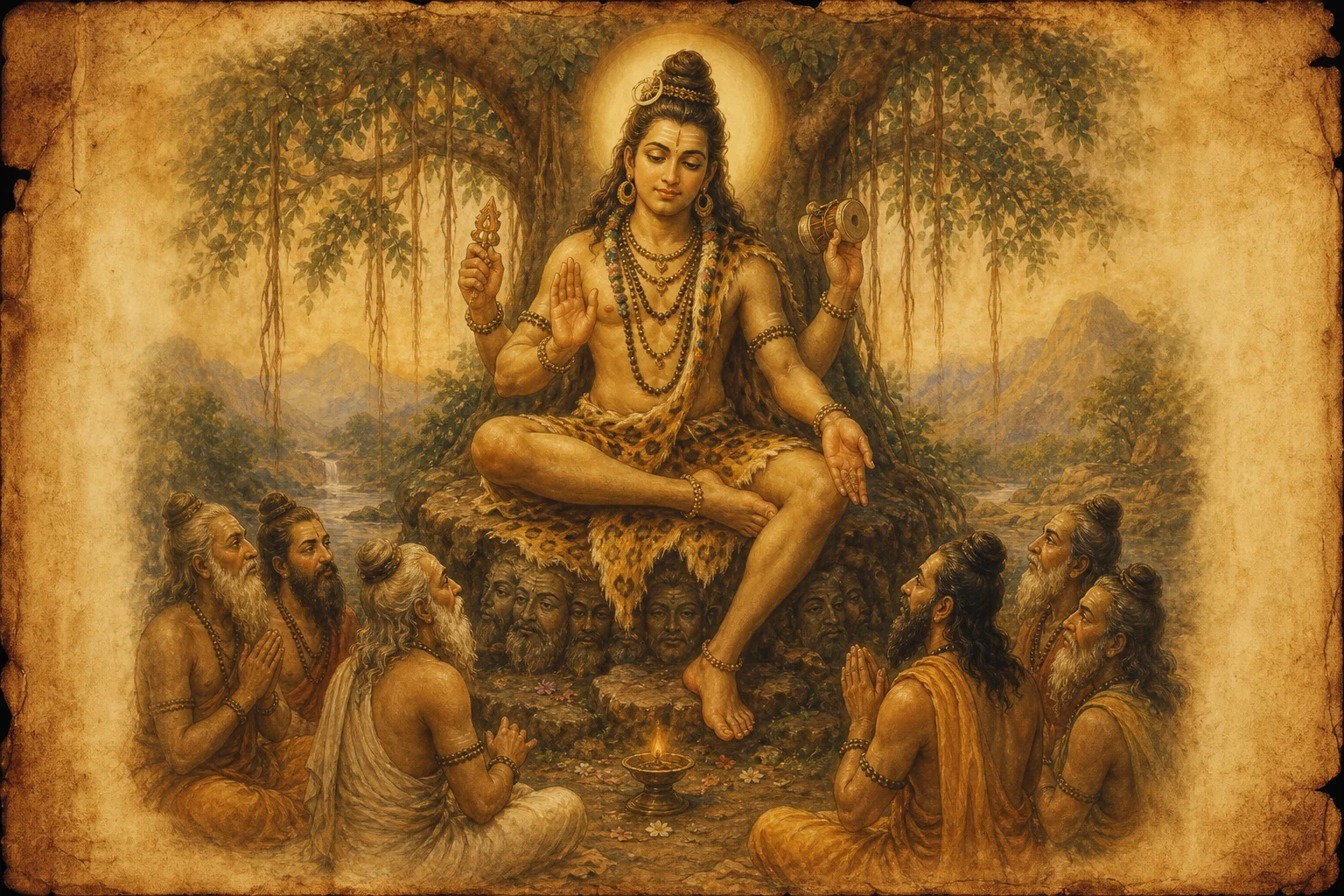
The stotra praises Dakshinamurti as Om, as the fulfiller of purusharthas, as the teacher holding the chin-mudra, vina, and book, as refuge for beings in the womb and for sages at the banyan root, and as the self-luminous reality beyond all multiplicity. Later verses turn explicitly Vedantic, teaching the inner ruler, the falsity of jiva-isvara division under maya's veil, and the witness consciousness beyond waking, dream, and sleep.
This edition follows the twenty-four varna verses plus the concluding phala (twenty-five stanzas total) as found in standard recensions. The workMeta catalogue figure of thirty-two may reflect an alternate numbering; the text here is complete for the varnamala proper.
At a glance
- Verses
- 25 verses
- Chant time
- About 12 minutes
- Attribution
- Traditionally attributed to Adi Shankaracharya
- Sanskrit source
- sanskritdocuments.org · All sources
Verse overview
- 1
Om, whose name the wise hold, is the light in which sky and world appear. Meditation on the south-facing Lord is turning the mind to the inner Self in which…
- 2
The Lord beneath the lotus feet grants life's aims and removes misfortune for the humble devotee. True puruṣārtha is fulfilled when the mind rests in the feet…
- 3
Sages freed from delusion worship the Lord with chin-mudrā, book, and vīṇā. The emblems of knowledge point to the one consciousness that is both taught and the…
- 4
Seated on the bull of dharma, he is adored with faith by those who seek siddhi. The compassionate Lord is the inner goal of every disciplined seeking.
- 5
Even in the womb beings trust him to cut the bonds of birth. Refuge in his lotus feet is the recognition that liberation begins with surrender to the Self.
- 6
Those who fear the ocean of becoming serve him at the banyan root. The teacher seated in silence is the witness in whom the terror of saṃsāra dissolves.
- 7
His splendour outshines rubies and the elemental lights because he is tejas itself. The Lord as light of earth, sky, and fire is the consciousness in which all…
- 8
Renouncing ritual rewards, the seeker of knowledge worships the Lord of the earth. When fruit of action is released, inquiry into the Self becomes the true…
- 9
The meritorious devotee sheds sorrow and rejoices in the inner Brahman. Worship ripens into direct joy in the supreme Self beyond the misery of becoming.
- 10
Devotees chanting the alphabet at the heart's centre rejoice, having grasped all scripture. The varṇamālā is the sonic form of the one Lord in whom all…
- 11
His face outshines snow, camphor, and nectar; laughter crowns the south-facing head. Beauty and joy in the Guru's form direct the mind to the bliss that is the…
- 12
Subtle and flawless, he is the ocean on whose waves the matted crest shines. The eternal, subtle Lord is the unchanging ground of the cosmic waters of…
- 13
Knowing him, all is known; nothing else is real like the hare's horn. The Lord who is the final goal is the Self in whom attainment and attainer are one.
- 14
Kāma was reduced to ash by the fire of his brow; devotees wear that sacred ash. Desire burned in the fire of knowledge leaves only the purity of the Self.
- 15
Firm devotion to his feet is the boat across the ocean of becoming. The all-pervading Lord of bliss is the far shore discovered as one's own nature.
- 16
Meditate on moon-crested Dakshinamurti with vīṇā and book, seen in half a glance. Silent contemplation of the Guru's form turns the mind inward to the witness…
- 17
He is the supreme light, cause of sun and moon and of the world's origin. As Lord of all, he is the one consciousness from which every light derives its…
- 18
Restrained devotees know him directly as the Self through prāṇāyāma and inward turning. Discipline clears the mind so the Lord is recognized as none other than…
- 19
The indwelling Lord prompts all beings in every action according to past karma. Recognizing him as the inner ruler loosens identification with the doer.
- 20
Wise men call him the meaning of Praṇava who moves breath and senses. Om resolves in the pure intelligence that is the Self of the devotee.
- 21
The Veda's crest declares: by his knowledge comes liberation from saṃsāra. The primal teacher is the Self whose nearness awakens and whose knowledge frees.
- 22
World and jīva-lordship are superimposed through avidyā's veil like water on the sun. Seeing through the veil, all difference collapses in the one light of…
- 23
The witness Self remains beyond waking, dream, and sleep as pure being-consciousness-bliss. He is kūṭastha, the immovable ground of the three states.
- 24
Sages cried in wonder when delusion ended and the inner Brahman stood revealed. The shock of recognition is the joy of discovering oneself as what was always…
- 25
May the supreme teacher accept this hymn composed in the manner of delighted peacocks. The prayer closes by identifying the Guru with paramātman, the Self of…
All verses
Open full textRelated works
Common questions
- When do people recite Dakshinamurti Varnamala Stotram?
- Guru hymns are commonly recited on Guru Purnima, Thursdays, and during remembrance of the teacher. This edition presents 25 verses and takes about 12 minutes to chant.
- What is the opening focus of Dakshinamurti Varnamala Stotram?
- Om, whose name the wise hold, is the light in which sky and world appear. Meditation on the south-facing Lord is turning the mind to the inner Self in which all gods and creation have their ground. Read verse 1 in Study mode for the full editorial note beside the Sanskrit.
- Which hymns pair well with Dakshinamurti Varnamala Stotram?
- On this site, related reading includes Dakshinamurti Ashtakam, and Dakshinamurti Stotram. Open those hubs for their own Sanskrit, English meaning, and study notes.