Complete · ~16 min chant
Rama Bhujanga Prayata Stotram
रामभुजङ्गप्रयातस्तोत्रम्
Rāmabhujaṅgaprayātastotram
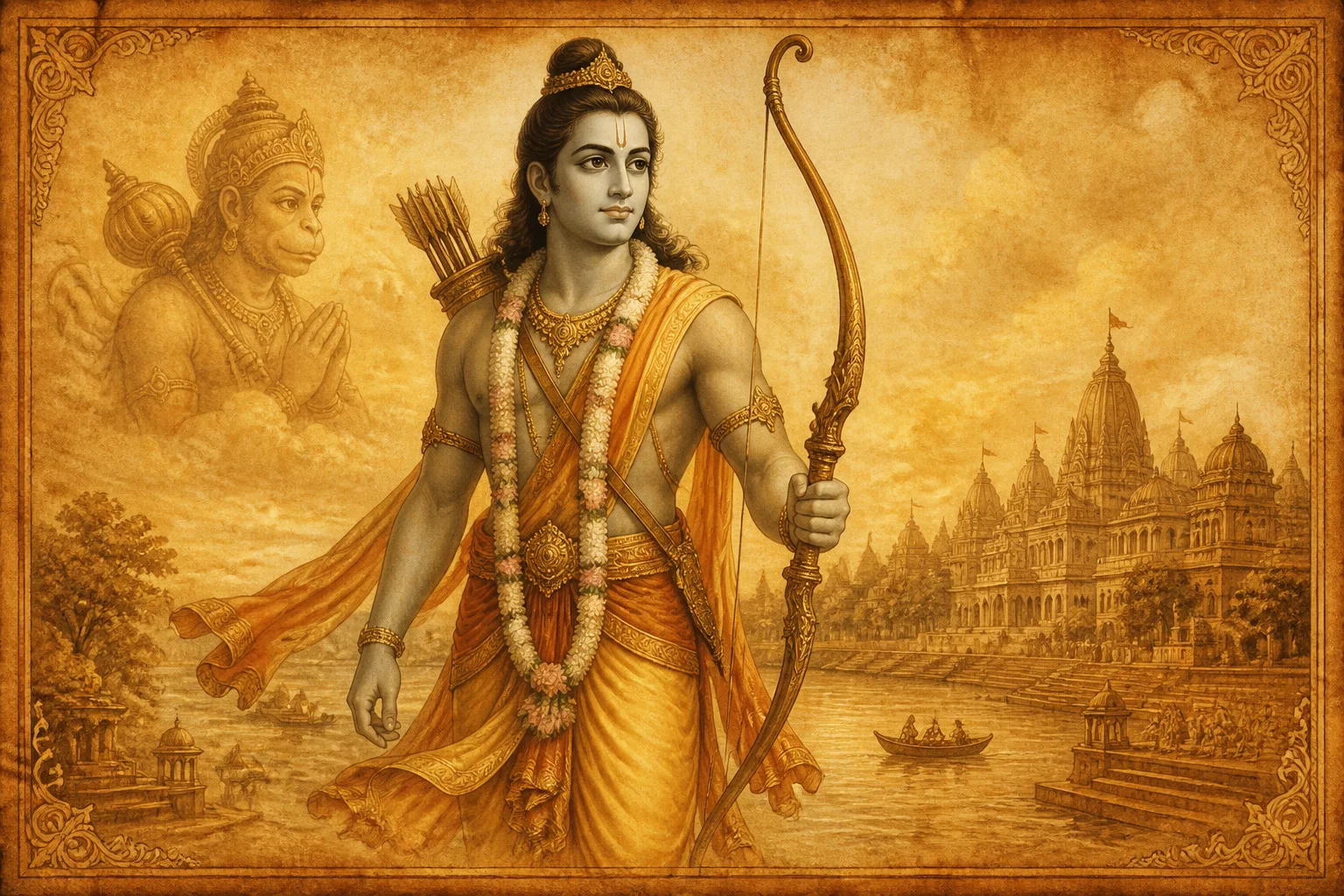
Twenty-nine verses in bhujanga metre praising Sri Rama as supreme refuge, Taraka-Brahman, and the devotee's heart-dwelling Lord.
29 verses · About 16 min · Shri Vishnu
How do you want to read?
Chant one verse at a time, or open the full text to scroll the whole hymn.
Rama Bhujanga Prayata Stotram is a twenty-nine-verse hymn to Sri Rama in bhujanga metre, following the Sringeri Sharada Peetham recension traditionally attributed to Adi Shankaracharya. It praises Rama as refuge and Taraka name. This edition includes Sanskrit, English meaning, and study notes.
Rama Bhujanga Prayata Stotram, in the Sringeri Sharada Peetham recension, is attributed to Sri Adi Shankaracharya and cast in the bhujanga metre whose rhythm glides like a serpent's movement. The hymn praises Sri Rama as pure existence-consciousness-bliss, the Taraka name whispered at death in Kashi, and the refuge who alone conquers the foes of the three worlds.
More about this stotra
This edition follows Sringeri's twenty-nine-verse text, with Devanagari, IAST, and editorial study notes for contemplative reading.
At a glance
- Deity
- Shri Vishnu
- Verses
- 29 verses
- Chant time
- About 16 minutes
- Attribution
- Traditionally attributed to Adi Shankaracharya
- Sanskrit source
- sringeri.net · All sources
Traditional context
Rama Bhujanga Prayata Stotram praises Sri Rama in the gliding bhujanga metre. Tradition attributes it to Shankaracharya; this edition follows the Sringeri Sharada Peetham recension.
The hymn holds Rama as existence-consciousness-bliss, the Taraka name linked with Kashi's liberation lore, and the refuge who conquers the foes of the three worlds.
Structure of this recension
Twenty-nine verses sustain lyrical praise rather than a brief ashtakam refrain pattern. The metre itself invites unhurried chanting.
Length rewards reading in daily clusters instead of forcing the full hymn into one strained sitting.
How to read this edition
Editorial study notes support contemplative reading of the Sanskrit. They are not a traditional bhashya and do not settle every recension variant outside the Sringeri-facing text used here.
Suggested practice
Take four or five verses a day to complete the hymn over about a week. Open with Hanumat Pancharatnam when you want Hanuman's service as prelude to Rama refuge.
Verse overview
- 1
Refuge in Rama as saccidananda turns devotion toward the Self that needs no outer support. The gunas are upheld by that which itself is beyond them.
- 2
Taraka is the name that ferries across; formless bliss is the goal the forms of worship serve. Lordship without a second lord is Advaita spoken in the language…
- 3
The name whispered by Shiva at death is the same Brahman the hymn worships in life. Repetition of 'I worship' is the mind's return to that one Taraka.
- 4
The jewelled seat and solar radiance are images for the heart's throne where Rama sits with Sita and Lakshmana. Worship here is remembrance of that nearness.
- 5
Anklets, yellow cloth, and Kaustubha draw the senses into beauty that points beyond ornament to the Lord who wears the world lightly.
- 6
Gods waving light at his feet show that even the highest powers adore the same Self. Moon-smile and solar blaze are one radiance of consciousness.
- 7
Teaching with chinmudra joins devotion and knowledge: Hanuman's folded hands meet the gesture of awareness. 'None other than you' is the refusal of every…
- 8
The prayer for Rama's appearance at death's approach is the seeker's trust that the Self reveals itself when fear is fiercest.
- 9
The heart as temple asks Rama to dwell within, served by dharma's companions. Grace is invited, not coerced.
- 10
Earthly and monkey armies image the many powers that serve the one Lord. Light granted by grace is knowledge of the Self.
- 11
Rama as sole deity is the universe's source; elements and living beings are his work. Pure consciousness is not an object among objects.
- 12
Four salutations gather being, lordship, love, and vision into one address. Janaki's life-lord is the Self that life depends on.
- 13
Merit, Veda, and beauty of Sri's beloved name the paths by which the mind approaches what devotion already loves.
- 14
Maker and mother, enjoyer and conqueror: cosmic functions collapse into one Rama so the devotee need not split the Absolute.
- 15
Skill in the world's play belongs to the Lord; the mind's work is service of his feet for the sake of awakened consciousness.
- 16
Ahalya's stone becoming conscious by foot-dust shows grace transforming inertia. Service of the feet is that same grace accepted.
- 17
Daily remembrance of Rama's story ends the terror of death because the remembered Lord is what death cannot touch.
- 18
Knowing Rama as crest-jewel and supreme abode is jnana clothed as bhakti. Beyond mind and speech yet near as refuge.
- 19
Childhood strength that broke Shiva's bow is limila power; the hymn asks how any measure could hold it.
- 20
Ravana's fort and hosts fall only before Rama. Dependence on the Lord is courage, not weakness.
- 21
Hanuman drinking the nectar of the name models the inner worship the devotee seeks: joy that pours from Rama alone.
- 22
Fear of death dissolves in the daily taste of Rama's name. Grace, not technique, is the stated cause.
- 23
Gods lacking Sita, bow, Lakshmana, and Sugriva's bond are refused. The hymn binds form, dharma, and friendship to the name Rama.
- 24
Without the hero's seat, chinmudra, and Hanuman's teaching, divinity is empty ornament. Rama must teach as well as rule.
- 25
Ocean, exile, smile, and unbroken awakening mark the complete Rama; truncated gods are set aside.
- 26
Calling Rama through every hour makes time itself a rosary. The friend of all looks on the one who keeps calling.
- 27
Lakshmana, Bharata, and the monkey lord praise the same Ramachandra. Salutation joins the whole circle of love around him.
- 28
Fierce to foes, kind to refugees: grace asked fourfold is the heart's only petition at the hymn's close of prayer.
- 29
Reading the bhujanga hymn with devotion is said to make one Ramachandra - identity of devotee and Lord in pure remembrance.
All verses
Open full textRelated works
Common questions
- Which recension does this edition follow?
- This working text follows the Sringeri Sharada Peetham twenty-nine-verse recension. Printed booklets sometimes vary in length; verse numbers here match that Sringeri-facing edition.
- How does it relate to Vishnu Bhujanga Prayata Stotram?
- Both use bhujanga-prayata metre for sustained Vishnu praise. This hymn centres Sri Rama as supreme refuge and Taraka; Vishnu Bhujanga Prayata Stotram is a separate work on this site. Open each hub for its own text.
- Why is Rama linked to Kashi in this hymn?
- The stotra praises Rama as the Taraka name associated with liberation at death in Kashi. That theme joins Rama-bhakti with the city's liberation lore without turning the hymn into a travel guide.