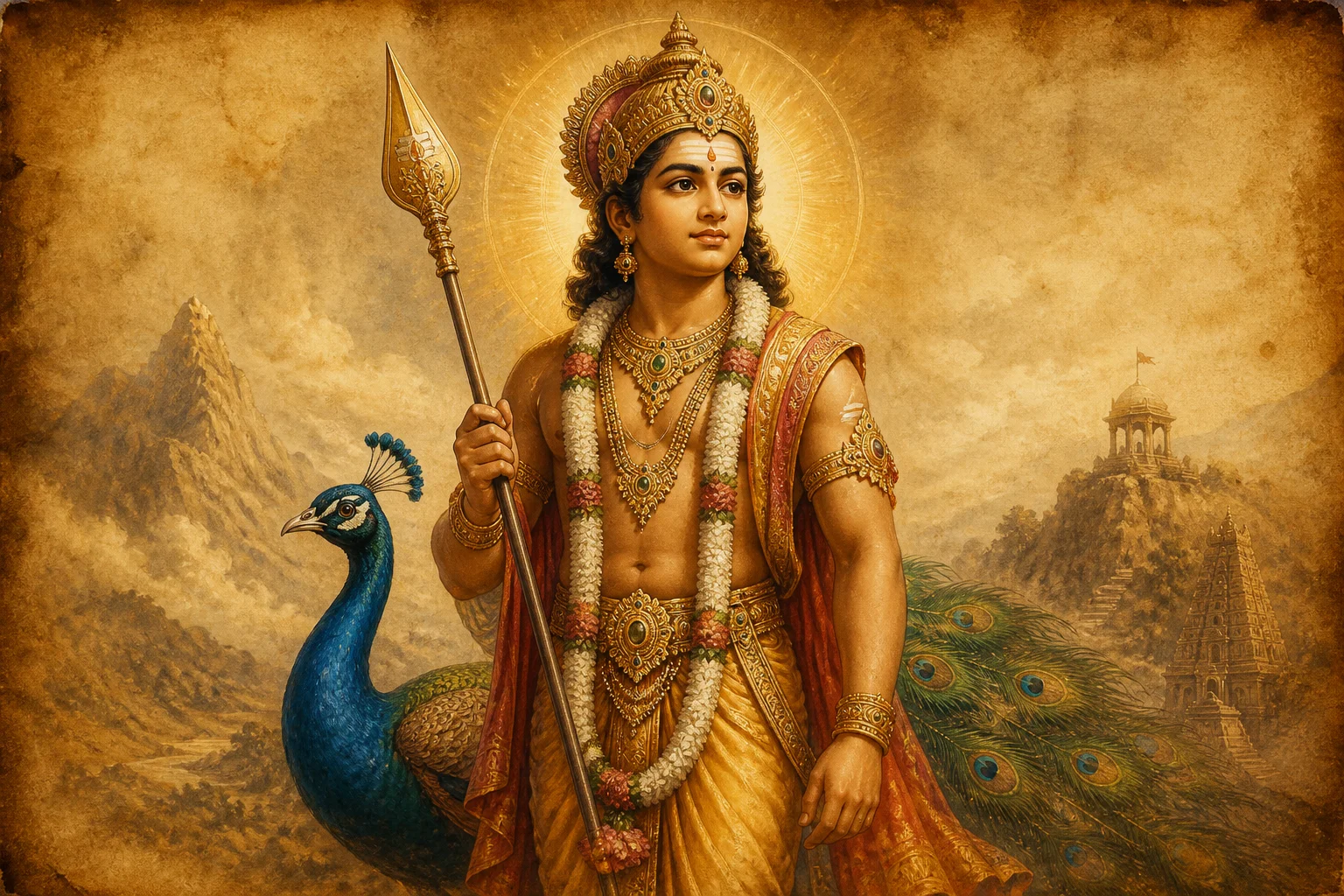
Complete · ~18 min chant
Subrahmanya Bhujangam
सुब्रह्मण्य भुजङ्गम्
Subrahmaṇya Bhujaṅgam
Thirty-three verses born at Tiruchendur, from Ganesha's blessing to prayer at life's final hour.
33 verses · About 18 min · Lord Subrahmanya
How do you want to read?
Chant one verse at a time, or open the full text to scroll the whole hymn.
Subrahmanya Bhujangam is a thirty-three-verse hymn to Skanda (Murugan) in bhujanga metre, traditionally attributed to Adi Shankaracharya. Tradition links it to his meditation at Tiruchendur. This edition gives Sanskrit, English meaning, and editorial study notes.
Subrahmanya Bhujangam is a major hymn attributed to Sri Adi Shankaracharya, said to have flowed spontaneously in the bhujanga metre when he meditated upon Lord Skanda at Tiruchendur on the Tamil coast. Tradition holds that the acharya beheld Adishesha worshipping the Lord and adopted this serpentine, musical metre.
More about this stotra
The stotra opens with Ganesha's blessing and the acharya's humility, then praises Skanda as the goal of the Mahavakyas, the guide across the ocean of samsara, and the dweller on the Sugandha hill. Long meditative sequences describe his feet, waist, chest, arms, faces, and eyes, before turning to fervent prayers for protection at death, destruction of mental sorrow, and surrender of the household to the Lord.
Thirty-three verses make this one of Shankara's longest single-deity bhujangams. It is treasured in South Indian Skanda devotion and recited especially during Skanda Shashti. This edition presents the complete text with curated focus notes inviting study rather than replacing traditional commentary.
At a glance
- Deity
- Lord Subrahmanya
- Verses
- 33 verses
- Chant time
- About 18 minutes
- Attribution
- Traditionally attributed to Adi Shankaracharya
- Sanskrit source
- sanskritdocuments.org · All sources
Traditional context
Subrahmanya Bhujangam praises Lord Skanda, also known as Murugan and Kartikeya. Tradition holds that the hymn flowed in bhujanga metre when Shankaracharya meditated upon the Lord at Tiruchendur on the Tamil coast.
It remains a cornerstone of South Indian Skanda devotion and is especially associated with Skanda Shashti.
Structure of this recension
Thirty-three verses open with Ganesha's blessing and the acharya's humility, then praise Skanda as goal of the mahavakyas and guide across the ocean of birth and death.
Long meditative sequences describe the Lord's form before turning to prayers for protection and surrender of the household to Skanda.
How to read this edition
Curated focus notes invite contemplative reading of the Sanskrit images. They are editorial study aids, not a claim to reproduce a traditional bhashya.
Suggested practice
During Skanda Shashti, chant a cluster of verses each day rather than rushing all thirty-three at once. Pair with Shiva Bhujangam if you want to hear the same metre turned toward Mahadeva.
Verse overview
- 1
Ganesha, though childlike in form, is sought by Brahma and Indra; may that auspicious Lord grant blessing. The hymn opens with the remover of obstacles before…
- 2
The acharya admits no mastery of metre; six-faced light in the heart pours forth inspired song. True praise arises not from literary skill but from the Lord's…
- 3
Skanda on the peacock is the hidden Mahavakya, delight of sages, essence of the Vedas, son of Mahadeva. The Lord who rides the peacock embodies the supreme…
- 4
Those who reach the Lord cross the ocean of samsara; he dwells on the shore as Parashakti's pure son. Nearness to Skanda is itself the crossing from bondage to…
- 5
Troubles perish at the Lord's feet as waves break on the shore; Guha is meditated in the heart-lotus. The image of waves subsiding teaches that calamities…
- 6
Climbing Sugandha hill equals climbing Kailasa; the six-faced Lord on the hill grants joy. Sacred geography merges with the supreme abode when devotion…
- 7
Guha shines in the cave on the fragrant hill by the sea, destroying devotees' sorrow. The Lord's own radiance in the sacred cave dispels the darkness of…
- 8
In a golden chamber on a ruby cot, Kartikeya shines like a thousand suns and grants desires. Meditation on the Lord's splendour fills the heart with the light…
- 9
The mind-bee troubled by worldly heat may rejoice hovering at Skanda's red, nectar-filled lotus feet. The troubled mind finds rest and sweetness at the Lord's…
- 10
Meditation on the waist adorned with bells, gold belt, and shining silk garment gathers the mind on the Lord's beautiful form. Each limb becomes a doorway of…
- 11
The chest reddened by embrace of Valli is offered to the foe of Taraka, full of grace to devotees. The Lord's love for devotees mirrors the tenderness shown to…
- 12
The twelve arms punished Brahma, rule the world as play, and protect the universe from foes. Skanda's power spans cosmic governance and the protection of…
- 13
Six full moons without blemish would barely match the effulgence of the Lord's six faces. The six faces radiate a beauty no natural splendour can equal.
- 14
Six lotus faces smile like swans; nectar overflows from red lips under glances like rows of bees. The Lord's faces are lotuses from which the nectar of grace…
- 15
With twelve long merciful eyes, what loss if the Lord casts a single sidelong glance? One glance of Skanda's compassion outweighs every worldly gain.
- 16
Prostration to the six crowned heads Shiva blessed, murmuring 'You are born of me, may you live long.' The father's blessing empowers the son who carries the…
- 17
Youthful son of the Destroyer of Tripura appears with jewels, silk, and spear before the devotee. The Lord's radiant form stands before the inner eye as the…
- 18
The child Kumar rushed from Uma's lap to Shiva's embrace when called 'Come, child.' The divine family scene reveals love that draws the devotee-child into the…
- 19
Eleven names of the Lord are invoked as protection against passion and fear. Each name gathers a facet of Skanda's grace - commander, spear-bearer, saviour of…
- 20
At life's end when senses fail, may merciful Guha appear before the helpless devotee. The Lord's presence at the hour of death is the devotee's supreme request.
- 21
When death's messengers threaten, may the Lord ride the peacock with spear and say 'Do not fear.' Skanda's arrival transforms the terror of Yama's hosts into…
- 22
Do not neglect the devotee at the final hour who can no longer speak in prayer. The plea acknowledges that grace must act when human effort has ceased.
- 23
Taraka and other foes were slain, yet inner mental sorrow remains; where else can one turn? External demons are conquered but the inner affliction needs the…
- 24
The friend of the helpless is asked to destroy mental worry that blocks devotion. Outer refuge is found in Skanda, but the inner obstacle of anxiety must also…
- 25
Diseases and spirits flee on seeing the Lord's sacred ash. The ash of Shiva's son carries the purifying power that drives away bodily and spiritual afflictions.
- 26
May sight hold Skanda's form, ears his praise, mouth his story, hands his service, body his servitude. Total absorption in the Lord replaces the scattered…
- 27
Gods grant boons to sages; for ordinary folk Guha alone is known as saviour. The Lord of the humble reaches those whom celestial favour often overlooks.
- 28
May householders worship, bow, praise, and remember Kumara always. The devotee's prayer extends to every member of the household, consecrating family life in…
- 29
Beasts, birds, pests, and diseases are pierced by the sharp Vel and destroyed. The Lord's spear extends protection beyond spiritual foes to every source of…
- 30
Parents forgive a child's faults; the world-father is asked to forgive all errors. The devotee approaches Skanda as a child appealing to the universal parent's…
- 31
Salutations to peacock, Vel, sheep, cock, ocean, shrine, and Skanda again and again. Every attribute and companion of the Lord is honoured as a channel of his…
- 32
Victory to the blissful Lord, ocean of joy, friend of all, giver of liberation. The hymn culminates in joyous affirmation of Skanda as the source of ananda and…
- 33
Daily recitation with devotion grants sons, wife, wealth, long life, and union with Skanda. The phala-shruti promises both worldly welfare and the ultimate…
All verses
Open full textCommon questions
- When is Subrahmanya Bhujangam especially recited?
- It is widely chanted during Skanda Shashti and in South Indian Murugan worship. Many devotees also use it as a longer weekly hymn rather than a brief daily ashtakam.
- Is this the same as Skanda Bhujangam or Murugan Bhujangam?
- Those names often point to the same tradition of praise to Subrahmanya in bhujanga metre. This hub presents the thirty-three-verse Subrahmanya Bhujangam attributed to Shankaracharya in the working recension used here.
- How does it relate to Shiva Bhujangam?
- Both are long bhujanga hymns attributed to the acharya. Shiva Bhujangam praises Mahadeva; this hymn praises Skanda as guide across samsara. Reading them together highlights shared metre and distinct deities.