Complete · ~18 min chant
Shiva Bhujangam
शिवभुजङ्गम्
Śivabhujaṅgam
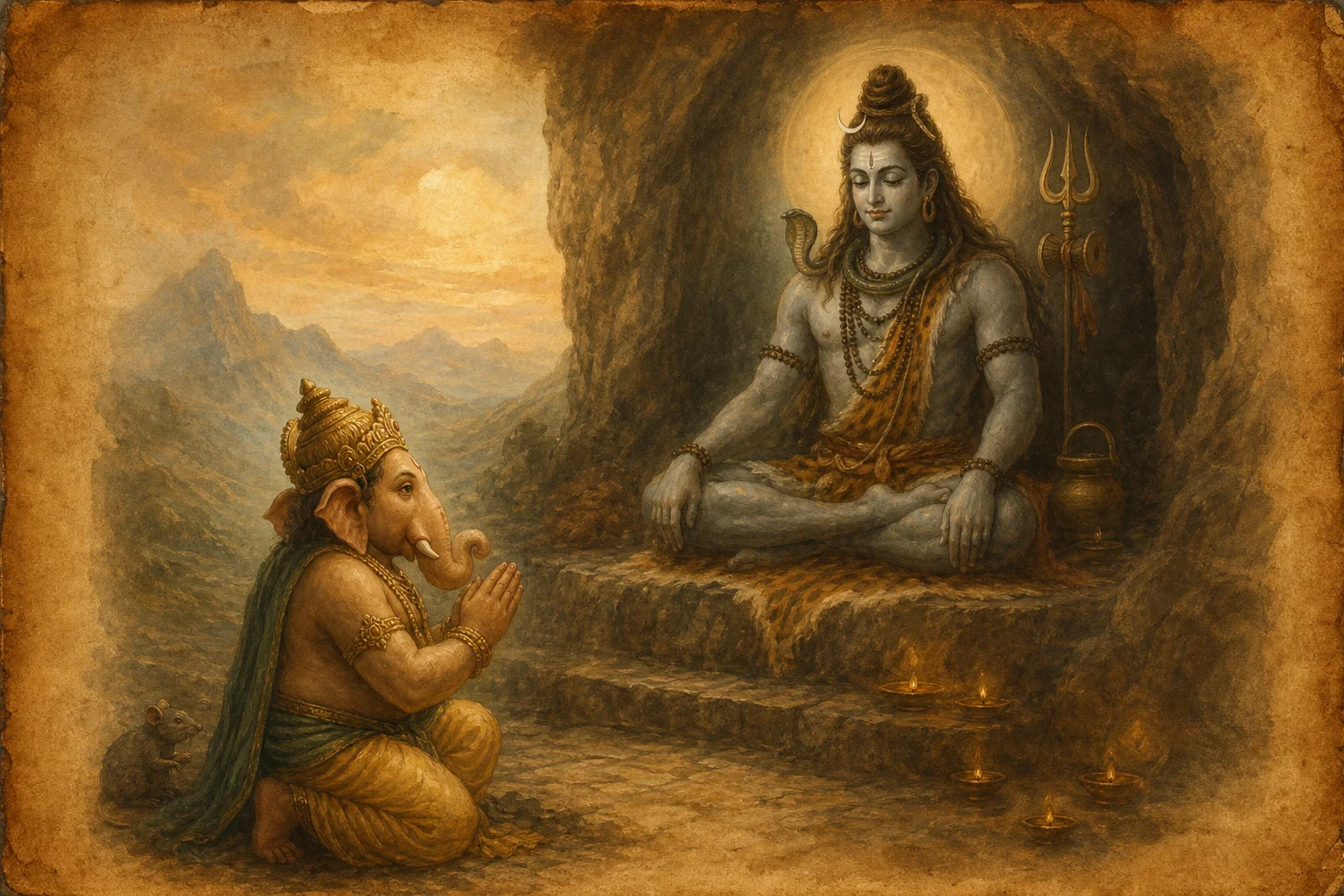
Thirty-three verses in bhujanga metre from Ganesha at the door to Mahadeva as pure consciousness.
33 verses · About 18 min · Lord Shiva
How do you want to read?
Chant one verse at a time, or open the full text to scroll the whole hymn.
Shiva Bhujangam is a thirty-three-verse hymn in the flowing bhujanga-prayata metre, traditionally attributed to Adi Shankaracharya. It moves from vivid praise of Shiva's form into Vedantic contemplation. This reader presents Sanskrit, English meaning, and editorial study notes.
Shiva Bhujangam (also called Shiva Stuti) is attributed to Sri Adi Shankaracharya and composed in the flowing bhujanga-prayata metre. It opens with dancing Ganesha and ascends through vivid praise of Shiva's five faces, matted locks, Ganga, poison-throat, and cosmic dance, before turning to Vedantic contemplation of the Lord beyond the thirty-six tattvas.
More about this stotra
Thirty-three verses place it among Shankara's longer Shiva hymns alongside Subrahmanya Bhujangam. The stotra is treasured in South Indian Shaiva devotion and pairs naturally with Shiva Panchakshara Stotram and Vishwanathashtakam. This edition presents the complete thirty-three-verse recension with Devanagari, IAST, and editorial focus notes.
At a glance
- Deity
- Lord Shiva
- Verses
- 33 verses
- Chant time
- About 18 minutes
- Attribution
- Traditionally attributed to Adi Shankaracharya
- Sanskrit source
- sanskritdocuments.org · All sources
- Guide
- Reading guide
Traditional context
Shiva Bhujangam is a major Shaiva hymn attributed to Shankaracharya and cast in the bhujanga-prayata metre. It is treasured in South Indian Shaiva devotion alongside shorter daily stotras such as Shiva Panchakshara.
The poem opens with dancing Ganesha and rises through praise of Shiva's form into Vedantic vision of the Lord beyond the tattvas.
Structure of this recension
Thirty-three verses move from opening auspiciousness through sustained description of form and attributes into contemplative surrender.
The length rewards reading in sections rather than forcing the whole hymn into a single hurried sitting.
How to read this edition
Each verse includes Devanagari, transliteration options, and an editorial focus note. These notes are study aids for contemplation, not a traditional bhashya or ritual manual.
Suggested practice
Take three to five verses a day to complete the hymn over about a week. Begin with Shiva Panchakshara if you want a short daily companion, or read beside Subrahmanya Bhujangam to hear the same metre turned toward Skanda.
Verse overview
- 1
Ganesha with dripping honey, swarming bees, and curved trunk is praised as the world's protector. The Lord who removes obstacles is the first gateway to Shiva,…
- 2
Shiva is beginningless yet primal, Turiya consciousness beyond speech and mind. What gods seek as the highest is the Self that cannot be grasped by thought or…
- 3
Five-faced Shiva on the lion-throne, adorned with Ganga and moon, friend of Parashakti. The Lord who spans all powers from creation to dissolution is…
- 4
The thirty-six tattvas cannot compass the supreme Lord known only to the wise. Philosophical categories map the manifest world but fall short of the reality…
- 5
Half the Lord is dark as coral stream, half bright as autumn cloud; meditated for smara's defeat. The Ardhanarishvara form unites ascetic stillness and…
- 6
Gods and demons who reach Shiva's service gain the fruit of all their penance. Surrender at the Lord's feet is the vessel that carries the soul across the…
- 7
The Lord of the universe is the compassionate refuge of those who surrender. Repeated salutation gathers the mind on the one reality that binds all beings as…
- 8
The three-eyed Lord is invoked as root of the Vedas and refuge from the downward path. His grace alone can lift the soul from the pull of ignorance toward…
- 9
Shiva is praised by names that mark his supremacy over desire, death, and even Vishnu. Devotional remembrance of the Lord who transcends all categories anchors…
- 10
For the surrendered soul there is no refuge besides Shiva. The devotee's sole plea is that the Lord's love for devotees never cease, for that love is the…
- 11
The devotee offers himself as the vessel of grace, asking only for steady bhakti. True fulfilment is not external boon but unwavering devotion to the Lord who…
- 12
Shiva accepts what the world rejects - the bull, the blemished, the serpent - and makes them his adornment. Those embraced by the Lord are blessed regardless…
- 13
The Lord's mercy confounds human judgment, extending even to those who sin against kin. His grace is not earned by moral calculus but flows from compassion…
- 14
Even imperfect worship reaches Mahesha when offered with dependence. Markandeya's father found that the Lord's feet alone could extinguish death's messenger,…
- 15
Shiva is the primal physician whose sacred ash heals every affliction. Bodily and spiritual disease alike find remedy in the Lord who lightens the burden of…
- 16
The devotee confesses total destitution while affirming that Shiva is the antaratma of all. The Lord who dwells within must know and rescue the soul that has…
- 17
A moment's glance from Shiva's eye makes earth and Lakshmi choose that place. The Lord's look transforms any spot into the centre of the universe, adorned with…
- 18
Shiva and Shakti are saluted as mother, father, and the unity beyond duality. Worship of the divine couple honours both the stillness and the power through…
- 19
Humility before the Lord's greatness opens the heart to grace. The devotee admits unfitness to praise yet trusts that Shiva forgives offences born of limited…
- 20
At the hour of death, when Yama's messengers approach, the devotee asks Shiva to ride his bull and whisper 'Do not fear.' The Lord's presence transforms the…
- 21
When Death's messengers speak harshly at life's end, the mind anchored on Shiva's feet alone can remain unmoved. Steadfast remembrance is the antidote to…
- 22
In the agony of dying, when speech fails and the body writhes, the devotee asks that Shiva's Ganga-adorned locks become the inner sanctuary. The Lord's form…
- 23
While loved ones mourn the dying body, the devotee resolves to repeat only 'Namah Shivaya.' Outer grief and inner remembrance diverge as the soul turns from…
- 24
When onlookers see only breath in the dying body, the devotee will meditate clearly on Shiva. Recognition that 'this is not he' is the very discrimination that…
- 25
When pain grips the body but delusion no longer grips the Self, the moon-bright form of Shiva remains in memory. The distinction between body-suffering and…
- 26
On the lonely path to death, without shade or companion, the devotee asks Shiva to block Yama's road and grant a pleasant passage. The Lord who conquered death…
- 27
Terror of hell and delusion at death drive the soul to cry for rescue. The moon-crested Lord is the only saviour when all other supports have vanished.
- 28
Shiva's compassion for devotees removes the fear of Death. The devotee sees no protector equal to the Lord of Parvati, whose power is broad and unconquerable.
- 29
Seeing Yama seize all without mercy, the singer begs Bhavanipati for fearlessness at death. Anxiety about imminent death dissolves only in refuge of…
- 30
Death seizes all regardless of age, inspiring terror in the witness. Only the grace of Shiva's lotus feet at the moment of death can confer the fearlessness…
- 31
Unbearable pains of old age and rebirth demand refuge in Shambhu alone. The devotee's cry awakens the question: will the merciful Lord's compassion respond?
- 32
May mind and speech never cease chanting Shivaya; grant this boon, O Maheshana. The five-syllable mantra is both liberator and death-slayer, the devotee's sole…
- 33
O moon-crested Lord, ferry this soul drowning in sorrow across the ocean of becoming. Shiva and Shakti together are the medicine that cures the disease of…
All verses
Open full textRelated works
Common questions
- What does bhujanga metre mean in this hymn?
- Bhujanga-prayata is a flowing metre whose rhythm is often compared to a serpent's glide. Shiva Bhujangam, Subrahmanya Bhujangam, and related works use that cadence for sustained lyrical praise.
- How does Shiva Bhujangam relate to Subrahmanya Bhujangam?
- Both are longer bhujanga hymns attributed to Shankaracharya and treasured in South Indian devotion. Shiva Bhujangam praises Mahadeva; Subrahmanya Bhujangam praises Skanda. Many readers study them as parallel metre companions rather than as one continuous text.
- Is Shiva Stuti another name for this work?
- Some traditions also call this hymn Shiva Stuti. On this site the working title is Shiva Bhujangam for the thirty-three-verse bhujanga recension.